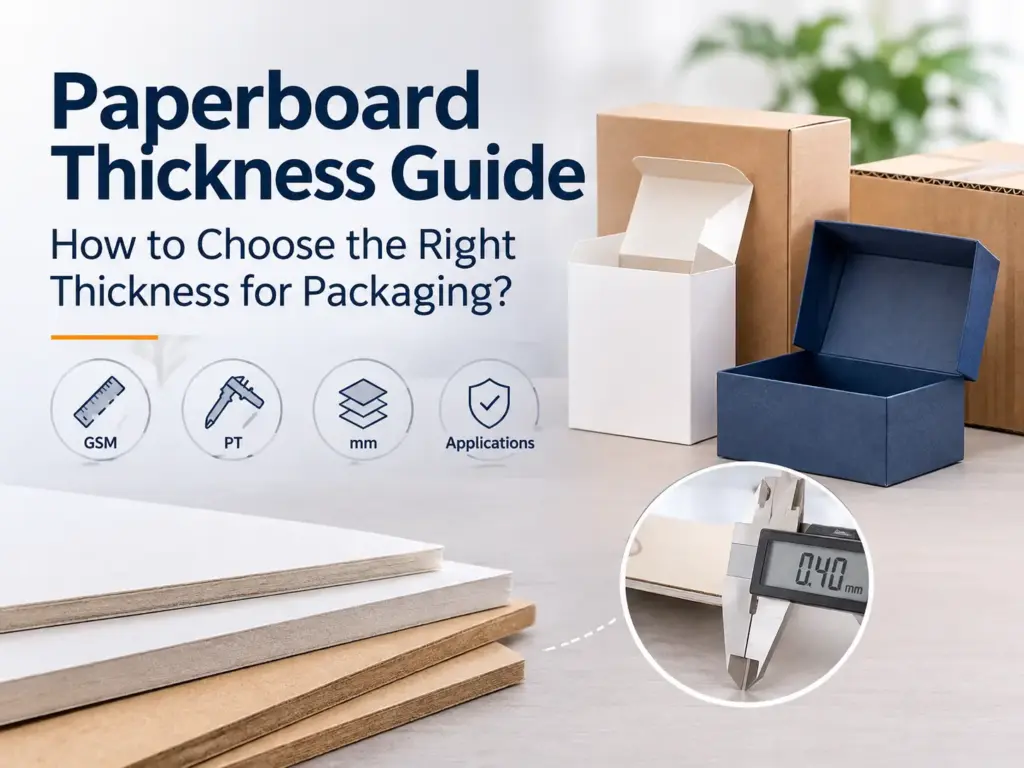
Many packaging buyers struggle to choose the right paperboard thickness, leading to structural weaknesses, inadequate product protection, or unnecessary material costs. These challenges become more significant as brands expand their product ranges, develop premium packaging, and place greater emphasis on sustainability and customer experience.
This guide explains how paperboard thickness is measured in GSM, PT, and mm, explores the characteristics of different paperboard materials, and shows you how to select the right thickness for different packaging applications. With a better understanding of these factors, you can make informed decisions that balance structural performance, product protection, and material efficiency.
Why Paperboard Thickness Matters in Packaging
Paperboard thickness influences the structural performance, appearance, and functionality of packaging. Selecting an appropriate thickness helps create boxes that meet product protection requirements while supporting efficient production and a consistent brand presentation.
Provides Product Protection and Structural Support
Paperboard thickness contributes to the rigidity and bending resistance of a packaging structure. The right material helps boxes maintain their shape during handling, storage, and transportation.
For products such as cosmetics, glass containers, and electronic accessories, sufficient structural support is important to reduce the risk of deformation. However, protection does not depend on thickness alone. Board strength, box construction, internal inserts, and distribution conditions also affect packaging performance.
Supports Printing and Finishing Quality
Paperboard selection also affects how packaging performs during printing and converting. Surface smoothness, coating, fiber composition, and board stability can influence print results and finishing quality.
Processes such as offset printing, foil stamping, embossing, and lamination should be considered when selecting a material. Explore our printing and finishing options to see how different processes are applied to custom paper packaging. The board must be compatible with the intended production process and maintain suitable folding and structural properties.
Influences Appearance and Customer Experience
The thickness and rigidity of a box affect how it looks and feels. A well-constructed package maintains clean edges, stable panels, and a consistent shape, helping create a more professional presentation.
This is particularly important for luxury, jewelry, and premium cosmetic packaging, where material quality and structural design contribute to the overall customer experience. The goal is not to choose the thickest board, but to find a suitable balance between appearance, functionality, and cost.
For premium product presentation, explore our custom rigid boxes, designed for luxury packaging applications.
How Is Paperboard Thickness Measured?
Paperboard specifications commonly use GSM, LB, PT, and millimeters. However, these units do not all measure the same property.
GSM and LB describe basis weight, while PT and millimeters describe caliper, or the actual physical thickness of the material. Understanding this distinction is important when comparing paperboard specifications from different suppliers.
GSM – Grams per Square Meter
GSM stands for grams per square meter and measures the weight of paperboard per unit of area. It is widely used to specify paper and packaging materials.
A higher GSM means more material weight per square meter, but it does not automatically mean greater thickness or stiffness. Different paperboard grades can have different densities and bulk, even when their GSM values are similar.
When comparing materials, GSM should therefore be considered alongside caliper, stiffness, and the intended packaging structure.
The measurement of paperboard grammage follows standardized procedures, such as those described in ISO 536:2019, which specifies how to determine the mass per unit area of paper and board.
LB – Pound Basis Weight
LB, or pound basis weight, is commonly used in North American paper and packaging specifications.
It describes the weight of a ream of paper based on a defined sheet size and number of sheets. The basis size varies according to the paper grade, so the same LB value cannot always be compared directly across different materials.
When reviewing specifications from suppliers, confirm the paper grade and basis-weight convention before comparing LB with GSM.
PT – Points
PT, or points, is a unit used to express paperboard caliper. One point equals 0.001 inch.
For example:
- 12 PT = 0.012 inches
- 16 PT = 0.016 inches
- 20 PT = 0.020 inches
A higher PT value indicates a thicker sheet. PT is commonly used in North American specifications for paperboard and cardstock.
However, caliper alone does not determine material strength. Fiber composition, density, and board construction also influence stiffness and performance.
Points vs. Mils: What’s the Difference?
Points and mils both represent thousandths of an inch:
- 1 PT = 0.001 inch
- 1 mil = 0.001 inch
Although their numerical values are equivalent, the terms are often used in different industries. Points are commonly used for paperboard and printing materials, while mils frequently appear in specifications for plastic films and coatings.
When comparing material specifications, check the unit and material type to avoid confusion.
MM – Millimeters
Millimeters (mm) are a metric unit used to express the physical thickness of paperboard.
For example, a board measuring 0.40 mm has a nominal caliper of 0.40 millimeters.
Millimeters are particularly useful when comparing international material specifications or communicating thickness requirements with packaging manufacturers.
How Is Paperboard Caliper Measured?
Paperboard caliper refers to the physical thickness of a sheet. It is commonly measured using a precision micrometer under controlled testing conditions.
The measuring pressure, instrument, sample preparation, and testing procedure can influence the result. For reliable comparisons, measurements should follow a consistent method.
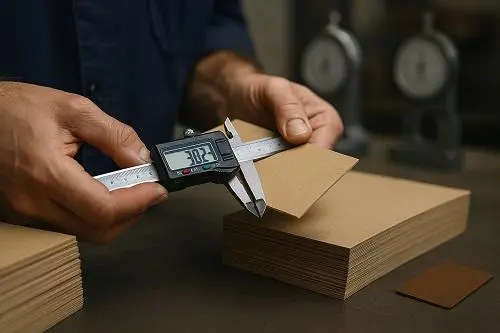
The TAPPI/ANSI T 411 standard describes a method for measuring the thickness and thickness variation of paper, paperboard, and combined board.
Paperboard Thickness Conversion Chart
Converting between PT, inches, and millimeters is straightforward because these units all describe physical thickness.
The following table provides exact unit conversions based on the relationship between points and inches.
| PT | Inches | Millimeters |
|---|---|---|
| 8 PT | 0.008″ | 0.2032 mm |
| 10 PT | 0.010″ | 0.2540 mm |
| 12 PT | 0.012″ | 0.3048 mm |
| 14 PT | 0.014″ | 0.3556 mm |
| 16 PT | 0.016″ | 0.4064 mm |
| 18 PT | 0.018″ | 0.4572 mm |
| 20 PT | 0.020″ | 0.5080 mm |
| 22 PT | 0.022″ | 0.5588 mm |
| 24 PT | 0.024″ | 0.6096 mm |
Important: GSM cannot be converted directly into PT or millimeters using a universal formula. Paperboard with the same GSM may have different caliper values depending on its fiber composition, density, coating, and manufacturing process.
When comparing paperboard materials, request both the basis weight and caliper specifications whenever possible.
Major Paperboard Material Types and Their Characteristics
Different paperboard grades offer different combinations of printability, stiffness, surface quality, and structural performance. Understanding these differences helps buyers select materials that match their packaging requirements.
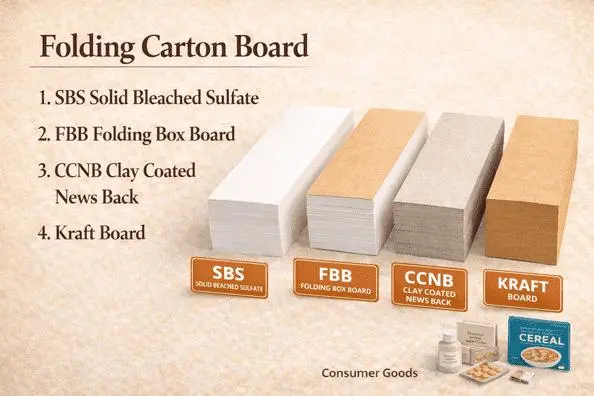
SBS (Solid Bleached Sulfate)
SBS is manufactured from bleached virgin fibers and typically features a clean white appearance and smooth surface.
Its consistent surface quality makes it suitable for high-quality printing and premium packaging applications. SBS is commonly used for cosmetic cartons, pharmaceutical packaging, and retail product boxes where visual presentation is important.
FBB (Folding Box Board)
FBB is a multilayer paperboard that combines different fiber layers to achieve a balance of weight and stiffness.
Its construction provides good bulk and structural performance without necessarily requiring a heavier sheet. FBB is widely used for folding cartons, including food, personal care, and consumer product packaging.
Explore our custom folding cartons to see different carton structures and packaging applications.
Kraft Paperboard
Kraft paperboard is recognized by its natural brown appearance and fiber-based texture.
It is often selected for packaging that emphasizes a natural or understated visual style. Depending on its grade and construction, kraft board can be used for folding cartons, sleeves, and other paper-based packaging.
CCNB (Clay-Coated News Back)
CCNB is a recycled paperboard featuring a clay-coated printing surface and a gray or recycled-fiber back.
It offers an option for packaging projects where cost and surface printability are important considerations. Its suitability depends on the required structural performance, printing specifications, and intended application.
Corrugated Board
Corrugated board consists of fluted paper material positioned between flaIn the European Union, food-contact materials must comply with Regulation (EC) No 1935/2004 and applicable requirements.t liner sheets. This structure creates cushioning and improves resistance to compression and handling forces.
Common flute profiles include A, B, C, E, and F. Larger flutes generally provide more cushioning, while smaller flutes can offer better printing and display characteristics.
Corrugated board is widely used for shipping cartons, e-commerce packaging, protective packaging, and product transport. For additional information about corrugated board construction and flute types, refer to the Fibre Box Association.
For more information about corrugated board construction and flute types, refer to the Fibre Box Association’s technical introduction.
How to Choose the Right Paperboard Thickness for Packaging
Choosing the right paperboard thickness requires more than looking at a GSM or PT value. The material should match the product, packaging structure, production requirements, and distribution environment.
Consider Product Weight and Protection Requirements
Start by evaluating the product’s weight, dimensions, and fragility.
Lightweight products may require less structural support, while heavier or fragile products may need stronger board grades, reinforced structures, or protective inserts.
Also consider how the product sits inside the box. Concentrated pressure on a small area can create different structural demands from a product whose weight is distributed evenly.
Match the Packaging Structure
Different box structures place different demands on paperboard.
Folding cartons need materials that can be scored, folded, and glued reliably. Rigid boxes use thicker greyboard as their structural core, while corrugated mailer boxes rely on fluted construction for protection during shipping.
The design should also account for crease lines, locking tabs, box dimensions, and load-bearing areas. A suitable material must perform well throughout both production and everyday use.
When developing folding carton packaging, factors such as board caliper, grain direction, crease design, and structural geometry should also be considered. Read our folding carton design guide to learn more about material selection and structural design.
Evaluate Shipping and Storage Conditions
Packaging may experience stacking pressure, vibration, repeated handling, and changes in temperature or humidity during distribution.
For products shipped over long distances or stored in stacked cartons, evaluate whether the packaging structure can maintain its shape under these conditions.
Corrugated board may be more appropriate for secondary shipping protection, while folding cartons and rigid boxes are commonly used as primary product packaging.
Balance Cost and Material Efficiency
Using thicker paperboard does not always produce better packaging. Excessive material weight can increase costs without providing meaningful improvements in performance.
Instead, compare different board grades and thickness options through material samples and structural testing.
Evaluating adjacent material specifications can help identify a suitable balance between protection, appearance, production efficiency, and material consumption.
Paperboard Thickness Recommendations by Packaging Application
Different packaging applications have different requirements for rigidity, protection, printing, and appearance. The following examples explain which material characteristics to consider when selecting paperboard.
Cosmetic Packaging
Cosmetic packaging often requires a balance of print quality, structural stability, and visual appeal.
SBS and FBB are commonly considered for folding cartons because of their smooth surfaces and suitable converting properties. Kraft paperboard can be used when a natural appearance is preferred.
For premium cosmetic gift sets or heavier products, rigid boxes with a greyboard core may provide the structural support and presentation required.

Jewelry and Luxury Packaging
Jewelry and luxury packaging place greater emphasis on structural rigidity and tactile quality.
Rigid boxes are commonly constructed using greyboard wrapped with printed or decorative paper. The appropriate greyboard thickness depends on box dimensions, product weight, structural design, and the intended presentation.
Internal inserts also play an important role in keeping jewelry, watches, and accessories securely positioned.

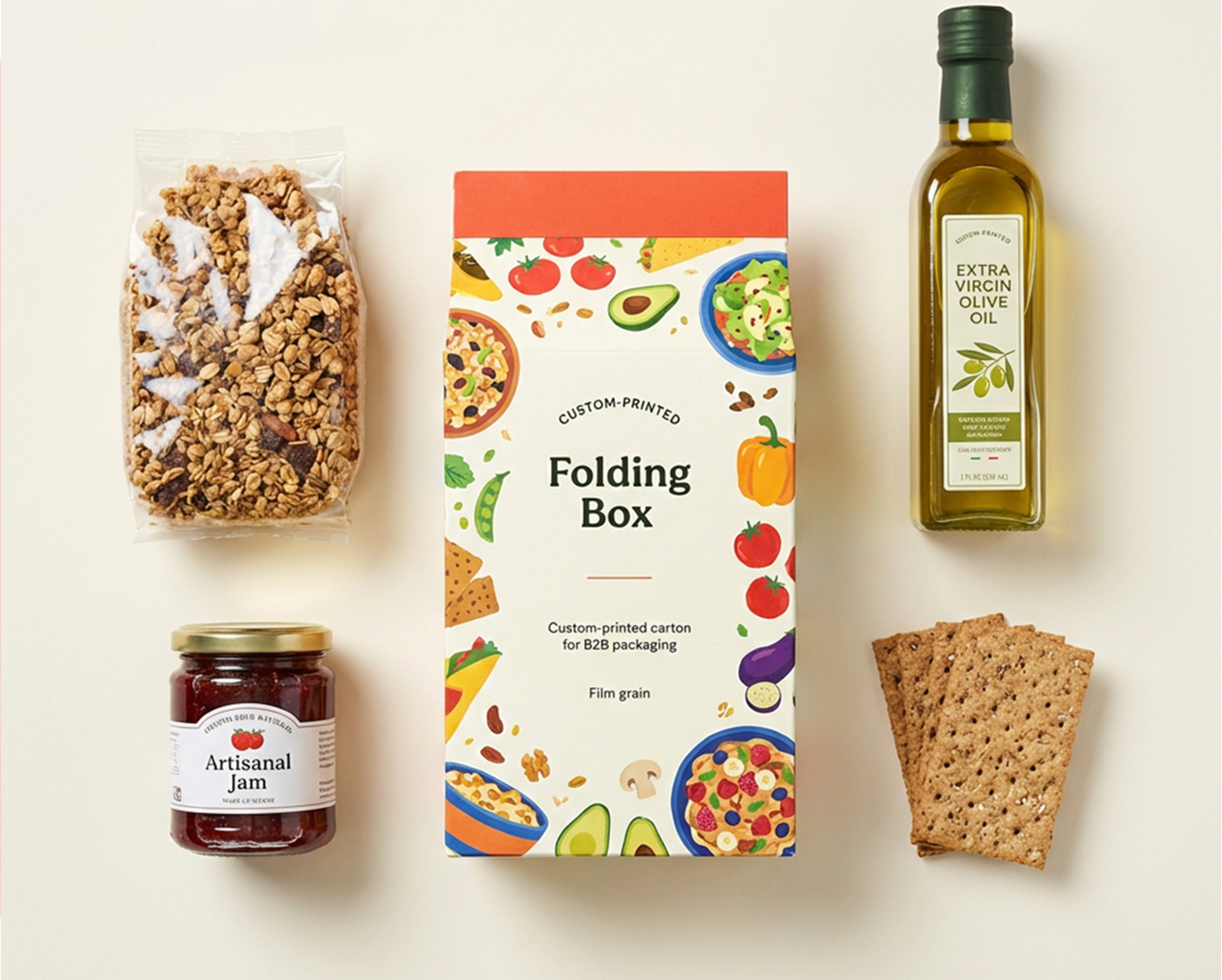
Food and Beverage Packaging
Food packaging requires careful material selection based on the product, storage conditions, and intended food-contact application.
SBS and FBB may be suitable for different folding carton applications, while coated or barrier-treated materials may be needed where moisture, grease, or other exposure is a concern.
For packaging intended to come into contact with food, material compliance must be evaluated separately from thickness. In the European Union, food-contact materials must comply with Regulation (EC) No 1935/2004 and applicable requirements for food-contact materials.
E-commerce Shipping Packaging
E-commerce shipping packaging must withstand handling, stacking, and transportation throughout the delivery process.
Corrugated board is commonly used because its fluted structure provides cushioning and structural support. The appropriate flute profile and board construction depend on the package dimensions, product weight, fragility, and shipping conditions.
For smaller products or premium retail presentation, fine-flute corrugated materials may also be considered.

How PACKCCP Helps You Select the Right Paperboard
Selecting the right paperboard is part of developing a packaging solution that performs reliably throughout production, storage, and distribution.
At PACKCCP, we consider product dimensions, weight, packaging structure, printing requirements, and intended use when evaluating material options.
Our packaging development process includes material selection, structural design, sampling, printing, finishing, and quality inspection. By evaluating these factors together, we help customers develop custom paper packaging that balances product protection, presentation, and material efficiency.
Whether you need folding cartons, rigid boxes, kraft packaging, or corrugated mailer boxes, the material should be selected according to the requirements of the complete packaging project rather than thickness alone.
Frequently Asked Questions About Paperboard Thickness
The ideal thickness depends on product weight, box structure, and protection requirements. Consider board caliper, stiffness, and intended application when selecting paperboard.
GSM measures paperboard weight per square meter, while thickness measures its physical caliper. A higher GSM does not always mean thicker paperboard.
Yes. Different paperboard grades, fiber compositions, and densities can result in different thicknesses at the same GSM. Always check the actual caliper when comparing materials.
SBS and FBB are common choices for folding cartons. SBS offers a smooth printing surface, while FBB provides a balance of stiffness and weight. The right choice depends on packaging requirements.
Consider the product weight, box structure, printing requirements, and desired appearance. SBS and FBB are suitable for many cosmetic folding cartons, while rigid boxes are often used for premium packaging.
Conclusion
Choosing the right paperboard thickness requires understanding how material weight, caliper, fiber composition, and packaging structure work together.
GSM helps compare basis weight, while PT and millimeters describe physical thickness. However, no single measurement can determine whether a material is suitable for every packaging application.
By considering product requirements, box construction, printing processes, and distribution conditions, you can select paperboard that provides the right balance of structural performance, visual quality, and material efficiency.
If you are developing custom paper packaging and need help evaluating material options, PACKCCP can support your project from material selection and structural design to sampling and production.