Ordering custom cosmetic packaging samples before mass production helps identify structural, printing, and finishing issues before they affect a full order. Samples also help confirm product fit, packaging dimensions, and overall appearance before final approval.
The process involves selecting the right sample type, preparing product specifications and artwork, reviewing the sample, and confirming any necessary revisions. Understanding each step helps brands reduce avoidable changes and prepare cosmetic packaging for mass production.
Types of Custom Cosmetic Packaging Samples
A sample that proves the structure and a sample that proves the color answer different questions, and most projects need both.
Not every sample answers the same question. A structural sample proves the box fits the product. A printed proof proves the color matches the approved reference. A finished sample with the insert fitted proves that the two work together.
Most cosmetic projects use two or three sample types in sequence. Knowing which one is under review prevents a later dispute about what was approved.
The sequence also depends on how new the structure is. A carton copied from an existing format needs little structural work, while a drawer box designed around three products usually needs more than one round before the fit is settled.
Structural Prototypes
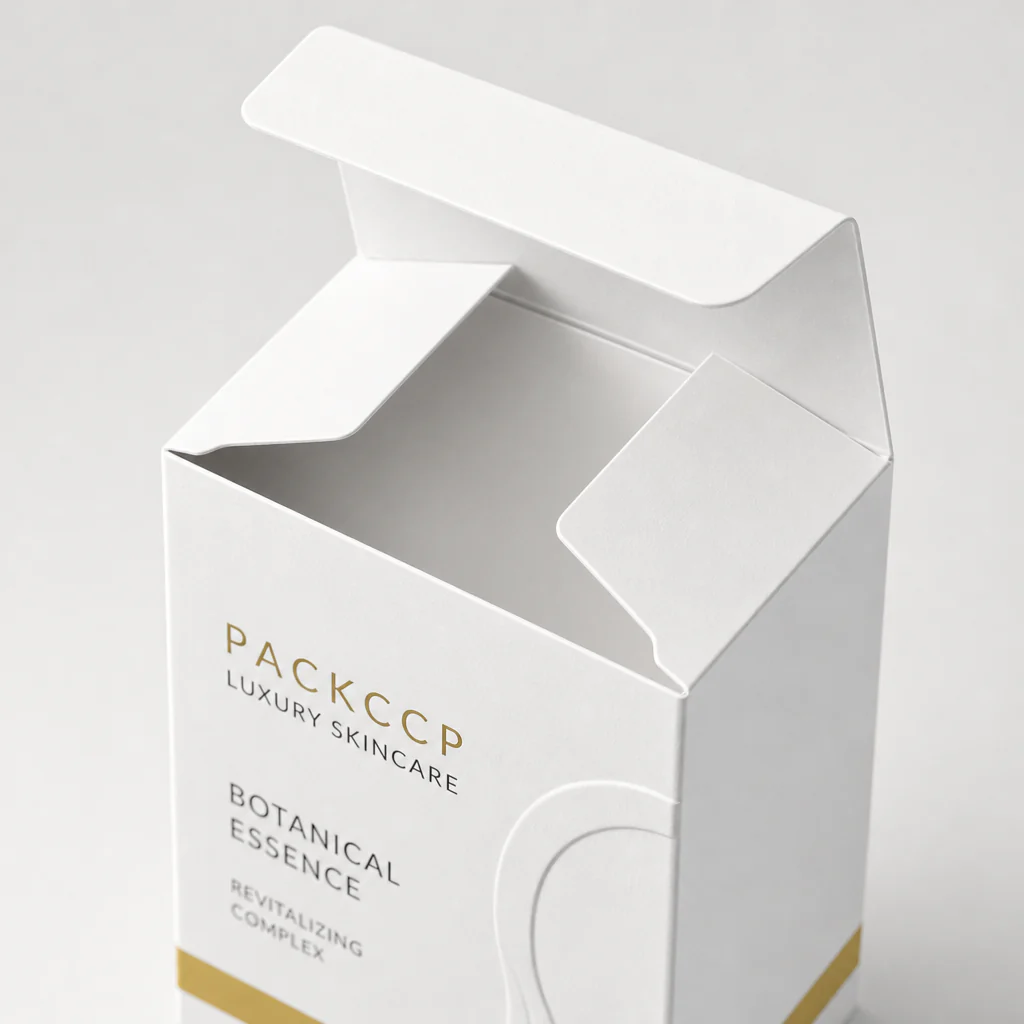
A structural prototype, sometimes called a white sample, is built from the specified board without printing. It confirms dimensions, folding behavior, closure strength, and how the box opens in use.
For beauty packaging this is the fastest way to test whether a cream jar clears the lid, whether a dropper bottle stands upright, and whether a drawer slides without binding.
- Internal dimensions measured against the filled container.
- Closure action repeated several times by hand.
- Insert cavities checked with the real product seated.
- Stacking and side pressure applied to the base and lid.
Printed Samples and Color Proofs
Printed samples move the project from structure to appearance. A digital proof checks layout, color separation, and text legibility. A production-matched proof is printed on the actual substrate with the actual ink system, so the color is close to what the offset run will produce.
The second option matters most when the design depends on a specific brand color, a metallic accent, or a dark solid background. Dark solids and large flat areas are where press variation shows up first.
Finished Samples With Custom Inserts
A finished sample combines the printed box with the insert, assembled the way it will ship. This is the sample that answers the commercial question: does the complete pack protect the product and present it correctly?
Paperboard, corrugated, and molded pulp inserts behave differently inside the same outer box. Assembly often reveals spacing problems that neither the dieline nor the flat proof shows.
| Sample type | What it validates | Best used for |
|---|---|---|
| Structural white sample | Dimensions, folding, closure, cavities | New structures and first-fit checks |
| Digital proof | Layout, text, color separation | Artwork review before plates |
| Production proof | Color on the real substrate | Brand colors, dark solids, metallics |
| Finished sample | Complete pack, protection, presentation | Final approval before production |
What to Prepare Before Requesting a Packaging Sample
Sampling moves faster when the manufacturer receives complete information in one round instead of three.
Incomplete briefs are the most common reason a sample arrives late. Each missing detail becomes a separate exchange of emails, and each exchange adds days to the schedule.
Product Dimensions and Box Requirements
Send the actual container or an accurate drawing with the widest point included. Record height with the cap fitted, diameter at the body and at the closure, and total weight.
If the product will sit inside a secondary carton or ship as part of a set, say so at this stage, because it changes the internal dimensions. The measurement points that matter on cosmetic containers are set out in our article on how to measure a box.
- Height with the closure fitted.
- Diameter at the body and at the widest point of the cap.
- Filled weight and center of gravity.
- Clearance needed for the insert and for removal.
Paper Material and Surface Finishes
Specify the preferred paperboard type and thickness, or ask the manufacturer to recommend suitable materials based on the product’s weight and packaging style. A serum carton and a rigid skincare gift box typically require different materials.
List the finishes you want to test, such as matte or gloss lamination, soft-touch coating, foil stamping, embossing, or spot UV. Testing these finishes on a sample helps confirm their appearance and compatibility before mass production.
Artwork Files and Brand Guidelines
Send print-ready artwork with outlined fonts, images at production resolution, and a separate reference for brand colors. Flag any element that must not move, such as a logo lockup or a regulated information panel.
If the artwork is still in development, request the dieline first and build the design on the correct template. Artwork placed on an outdated dieline is usually discovered after plates are made.
Add the commercial context as well: target order quantity, the date the boxes are needed in the warehouse, and the destination market. Also provide the target order quantity, required delivery date, and destination market. These details help the manufacturer assess tooling costs, production scheduling, and any applicable packaging or labeling requirements.
The Cosmetic Packaging Sampling Process
A sampling round ends with a decision rather than an opinion, and each stage should close before the next one opens.
A well-run sampling process has three stages. Keeping them separate is what keeps a project on schedule, because a revision made during production costs far more than a revision made on a sample.
Structure Design and Dieline Development
The manufacturer converts your dimensions and structural choice into a dieline: the flat drawing that defines every cut, crease, panel, and glue area.
For a standard format the dieline already exists and can be issued quickly. For a new structure it is drawn and checked against the product before any material is cut. The drawing itself is explained in our article on what a packaging dieline is.
Sample Production and Review
Once structure and artwork are agreed, the sample is produced on the specified material. Review should be systematic rather than impressionistic: check dimensions against the product, confirm the closure action, compare color to the approved reference, and assemble the insert with the product inside.
Revisions and Final Approval
If something is wrong, describe the correction in measurable terms. A lid that is too tight becomes a lid that needs 1.5 mm more clearance on the short side, which the sample room can act on without a second conversation.
Final approval means signing off a physical sample that becomes the production reference. From that point the approved sample, not the digital file, is the standard the run is checked against.
What to Check Before Approving a Sample
Approval transfers responsibility for the design to production, so the same checklist should run on every round.
Box Dimensions and Closure
Insert the actual product, close the box the way a customer would, and repeat several times. Check that a tuck flap stays closed, that a magnetic closure meets cleanly, and that a drawer slides without catching.
Print Quality and Color Matching
Compare the sample to the approved color reference under neutral light, not under office lighting or a phone flash. Look for registration errors on fine type, voids in solid areas, and consistency between panels.
Where a job depends on a repeatable color standard, the characterization data published by Fogra gives both the printer and the brand a measurable target instead of a subjective one.
Insert Fit and Assembly
With the product seated in the insert, turn the closed box upside down and shake it gently. Nothing should shift, rattle, or press against the printed surface.
Check that the insert sits flush in the base, that multiple cavities line up with their products, and that removing one item does not disturb the others. Our article on cosmetic packaging inserts for product protection covers the test sequence in more depth.
| Check | What to look for | Failure sign |
|---|---|---|
| Dimensions | Product seats with controlled clearance | Bulging walls or a lid that will not close |
| Closure | Repeatable open and close | Flap lifting after several cycles |
| Color | Match on the production substrate | Shift between panels or against the reference |
| Insert | Product held without movement | Rattle when the closed box is shaken |
Common Sampling Issues and How to Avoid Them
Most sampling problems trace back to an input rather than to the manufacturer, and the usual three are preventable.
Incorrect Dimensions
The usual cause is a dimension taken from a drawing rather than from the physical container, or a measurement taken before the cap was fitted. Send the container itself, or measure it with the closure in place and record the widest point.
Color Differences
Color complaints come from three sources: an uncalibrated monitor used as the reference, a proof printed on a different substrate, or a brand color specified only as a CMYK build. Approve a physical standard, and specify spot colors where the brand depends on them.
Changes After Sample Approval
Any change after approval reopens the risk that the sample was meant to close. Where a change is unavoidable, ask for a revised sample or at least a proof of the changed panel, and record which version is approved.
Version control on the dieline and artwork is the simplest defense. The questions worth asking about sampling, revisions, and production handover are set out in our article on choosing a cosmetic packaging supplier in China.
FAQs
1. Can I get custom cosmetic packaging samples before mass production?
Yes. You can request structural prototypes, printed proofs, or finished packaging samples before placing a mass production order. The sample type depends on whether you need to check dimensions, artwork, printing, finishes, or the complete packaging assembly.
2. What information do I need to request a cosmetic packaging sample?
Prepare the product dimensions, preferred box style, material requirements, artwork files if available, desired finishes, estimated order quantity, and delivery timeline. If the design is not finalized, you can start with the product itself or a reference image and discuss the structure with the manufacturer.
3. How long does custom cosmetic packaging sampling take?
Sampling time depends on the packaging structure, material availability, printing requirements, and finishing processes. PACKCCP lists a typical sampling timeframe of 3–5 days for its cosmetic packaging services. Confirm the timeline for your specific project before placing the order.
4. How much does a custom cosmetic packaging sample cost?
The cost depends on the box structure, materials, printing, finishing, inserts, and whether custom tooling is required. Ask the manufacturer to clarify sample charges, tooling fees, shipping costs, and whether any sample costs can be credited toward a later production order.
5. What should I approve before mass production?
Confirm the physical sample, product fit, box dimensions, material specifications, artwork, print colors, finishing details, and insert assembly. Keep the approved sample and final production files as references for quality inspection during mass production.
Sampling Readiness Before Mass Production
Custom cosmetic packaging samples help brands check product fit, print quality, materials, and finishing before committing to a full production run. The right sample depends on the packaging structure and the details that need approval.
PACKCCP supports custom paper packaging development, from dieline design and material selection to sample production and finishing. Share your product dimensions, packaging requirements, artwork, and estimated order quantity to discuss a suitable sample for your project.