A mailer box can survive delivery and still fail as packaging.
We see this when a product reaches the customer undamaged, but the bottles have shifted, accessories are buried under filler, or the first thing the customer sees after opening the box is empty space.
That is where the insert matters.
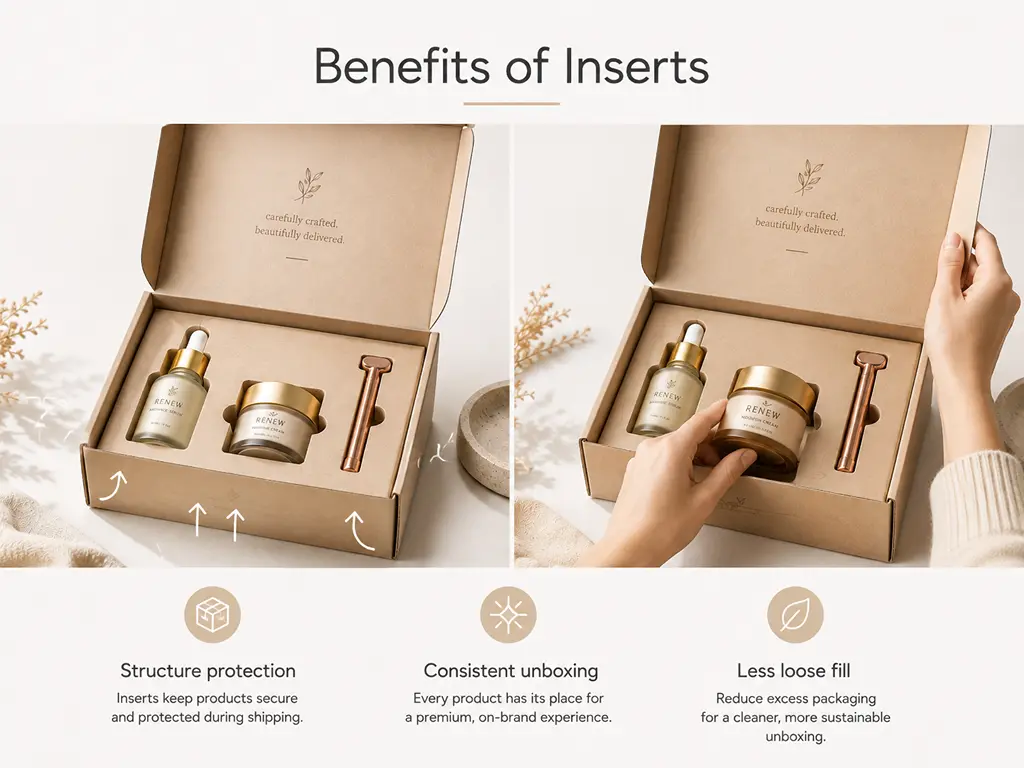
Custom mailer boxes with inserts combine a corrugated outer box with an internal structure designed around the actual product. The mailer handles shipping and presentation; the insert controls movement, separation and product position.
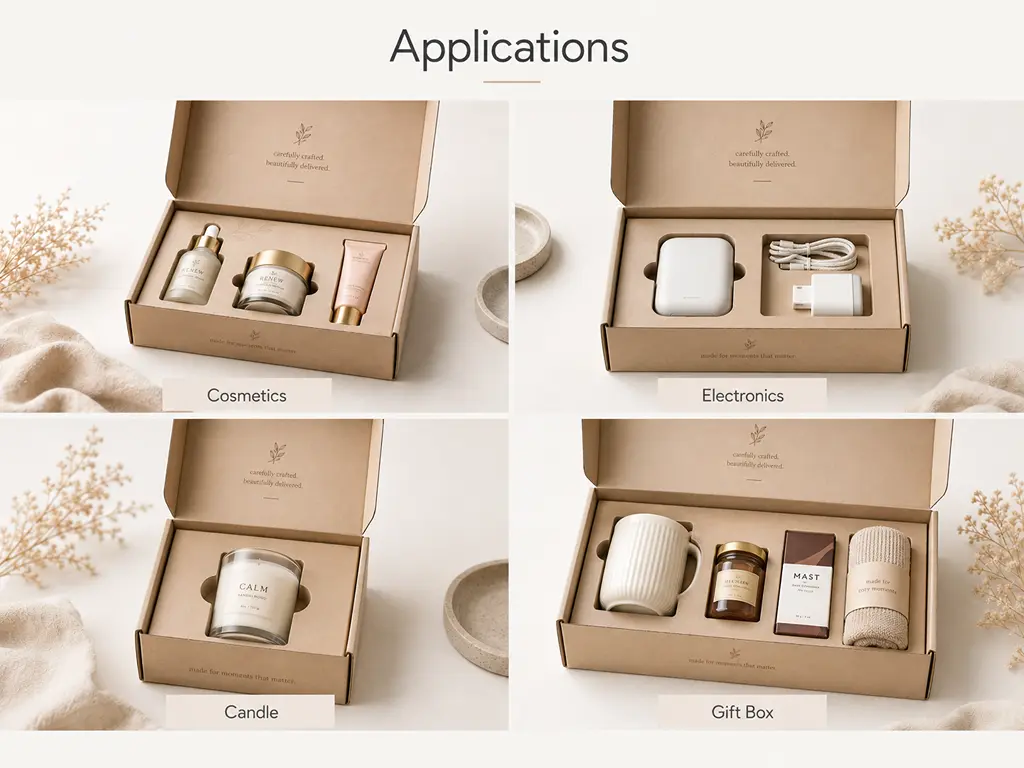
For cosmetics, 양초, 전자 장치, wellness products, subscription kits and multi-product gift sets, these two parts work best when they are engineered as one packaging system.
Brands comparing structures can explore PackCCP’s 맞춤 우편물 상자 and available insert configurations before developing a prototype.
빠른 답변: The best mailer box insert is not necessarily the tightest or most expensive one. It is the structure that keeps the product stable, allows easy removal, packs efficiently and uses only as much material as the product actually needs.
What Are Custom Mailer Boxes with Inserts?
A typical mailer packaging system has two main components:
- A custom-sized corrugated mailer box
- A fitted tray, divider or support structure inside it
Unlike shredded paper, packing peanuts or loose void fill, an insert gives each product a defined position.
Imagine a skincare set containing a serum bottle, moisturizer jar and facial oil. On a design screen, those three products may appear easy to arrange.
In reality, they can have different weights, cap diameters, heights and surface finishes.
If all three share an open cavity, the heavier bottle may move into another product during transit. A fitted insert limits that movement before it becomes damage.
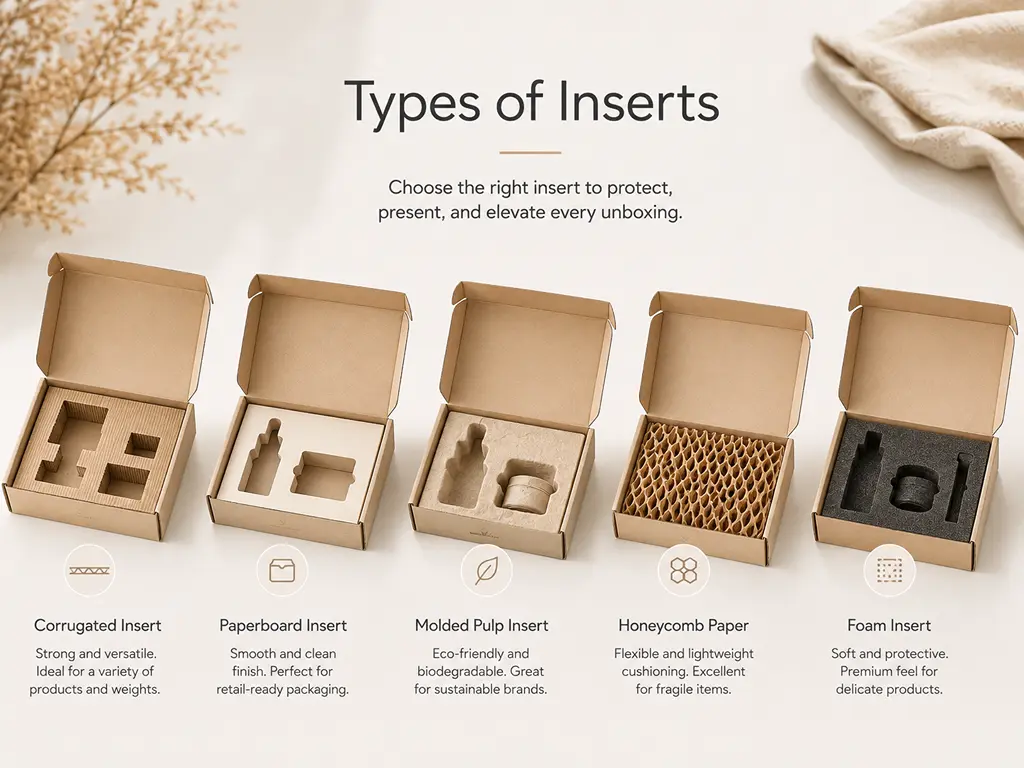
Common structures include:
- Die-cut cavities
- Bottle and jar holders
- Folded paperboard platforms
- Corrugated locking supports
- Product dividers
- Multi-level trays
- Molded fibre inserts
- Honeycomb structures
PackCCP’s mailer box quotation page shows several insert options, including corrugated dividers, 판지 삽입물, multi-layer corrugated structures, molded pulp and cushioning materials.
Why Use an Insert Instead of Loose Filling?
The biggest advantage is not simply a cleaner appearance.
An insert gives the packaging designer more control over what happens after the parcel leaves the packing table.
It Controls Product Movement
Products rarely remain exactly where they were packed.
Boxes are lifted, tilted, stacked and exposed to vibration and impact. A fitted internal structure limits the distance an item can travel before it reaches another product or the wall of the mailer.
That matters particularly for:
- Glass bottles
- Cosmetic jars
- Candles
- 전자 장치
- Small devices
- Premium accessories
- Multi-piece kits
It Makes the Unboxing More Consistent
Without a fitted structure, ten customers may open the same product and see ten slightly different arrangements.
A well-designed insert gives the brand more control over the first view.
That consistency is especially valuable for:
- PR kits
- Influencer mailers
- Subscription boxes
- Launch campaigns
- DTC gift sets
It Can Reduce Loose Void Fill
A right-sized box and insert can reduce reliance on excessive tissue, shredded paper and air pillows.
미국. Environmental Protection Agency notes that moving toward lighter or more efficient packaging construction can reduce waste and material use.
The important word is 효율적인.
Removing cushioning simply to reduce material is not an improvement if more products arrive damaged.
Product protection and material reduction have to be considered together.
Read the 우리를. EPA Sustainable Packaging guidance for the broader material-efficiency principle.
Choosing the Right Insert Material
There is no universal best insert.
packccp에서, material selection normally starts with product weight, 취약성, 표면 마무리, packing process and distribution environment rather than appearance alone.
| Insert Type | Best Suited For | Main Strength | Watch For |
|---|---|---|---|
| Corrugated insert | Bottles, 양초, 전자 장치, heavier products | Strong structural support | Exposed flute edges can look more industrial |
| 판지 삽입물 | 화장품, 부속품, lightweight kits | Clean appearance and printability | Limited cushioning for heavier products |
| Molded fibre insert | 아름다움, 전자 장치, personal care | Three-dimensional product fit | Tooling and natural surface texture |
| 벌집 종이 | Heavy or high-value products | High compression strength | More structure than lightweight products may need |
| 폼 인서트 | Fragile equipment and complex shapes | High cushioning and precise fit | Less suitable for paper-dominant packaging goals |
When Corrugated Inserts Work Best
Corrugated structures are useful when the insert needs to do real mechanical work.
They can be folded into:
- Supports
- Bridges
- Partitions
- Locking sections
- Multi-level platforms
without adding excessive weight.
We would generally favor corrugated over thin paperboard when several heavy glass containers must stay upright or when the product needs support from more than one direction.
The trade-off is appearance.
Exposed corrugated edges can feel more technical or industrial than a smooth printed paperboard tray, so material choice needs to match the brand as well as the product.
For more background on flute construction and board performance, 보다 골판지 상자는 어떻게 만들어지나요??.
When Paperboard Is Better
Paperboard works particularly well when the product is relatively light and the customer-facing presentation matters more than cushioning.
Typical applications include:
- Skincare sets
- Perfume samples
- Small accessories
- Promotional kits
- Lightweight wellness products
Paperboard can also be printed, allowing instructions, product names or campaign messaging to continue into the insert.
One issue we often see during insert development is a buyer asking for the cavity to be made as tight as possible.
That sounds logical.
A tighter cavity should mean less movement.
In practice, it can create a different set of problems.
A bottle that is gripped too tightly may be difficult to remove. Labels can scuff against the edge of a cutout, and small dimensional differences between product batches may cause some units to fit while others do not.
Controlled clearance is usually more useful than maximum tightness.
When Molded Fibre Makes Sense
Molded pulp or molded fibre is useful when the product needs a deeper, three-dimensional nest rather than a folded platform.
It is increasingly used for:
- 화장품
- Personal care products
- 전자 장치
- Small appliances
- Wellness products
Its natural texture is also part of the design.
That can work very well for organic, minimalist or sustainability-led brands. A luxury brand seeking a highly polished interior may require a different surface treatment or another insert material.
Five Questions We Ask Before Designing an Insert
The insert material should not be chosen first.
The product should drive the decision.
How Heavy Is the Product?
A lightweight tube behaves very differently from a glass candle or a set of three filled cosmetic bottles.
Heavier products usually require stronger support and better load distribution.
What Can Actually Be Damaged?
Fragility is not limited to breakage.
A product may survive transit structurally but still arrive unacceptable because:
- A label is scratched
- A pump is bent
- A coated bottle is rubbed
- A cap is loosened
- Two components collide
- A decorative finish develops pressure marks
For premium products, cosmetic damage can matter almost as much as structural damage.
Can the Product Vary Between Batches?
Nominal dimensions are useful, but they are not always enough.
Bottles, 항아리, caps and assembled products can vary slightly from sample to sample.
An insert therefore needs enough tolerance to accommodate normal production variation without becoming loose.
Physical samples are preferable when fit is critical.
How Will the Box Be Packed?
A structure can look excellent in a rendering and still be a poor commercial design.
If warehouse staff need several minutes to fold the insert, locate multiple tabs and force products into tight openings, labor quickly becomes part of the packaging cost.
During sampling, we look at:
- Number of folding steps
- Whether glue is required
- Loading sequence
- Risk of incorrect assembly
- Product removal
- Whether the insert can be supplied pre-assembled
~에 100 units, an awkward folding step may be manageable.
~에 10,000 units, it becomes an operational problem.
How Will the Package Travel?
A locally delivered PR kit does not experience the same distribution environment as an ecommerce parcel crossing several sorting hubs.
Before structural development, it helps to know:
- Parcel or pallet shipping
- Package weight
- Shipping distance
- Carrier environment
- Stacking conditions
- Existing damage history
그만큼 제품 + 끼워 넣다 + mailer should be treated as one system.
A Common Design Problem: Tighter Is Not Always Safer
One recurring issue appears when a brand asks us to eliminate all visible movement.
The first instinct is often to reduce the cavity size.
That can solve one problem and create another.
Consider a coated glass bottle in a die-cut paperboard tray.
Tightening the opening may reduce lateral movement, but it may also increase friction around the label and make the bottle uncomfortable to remove.
A better approach may be to support the bottle lower on the body, add a folded locking feature or control movement from another direction.
This is why insert engineering should focus on movement paths and contact points, not simply empty space.
The smallest cavity is not automatically the safest cavity.
When a Simple Paperboard Insert Is the Wrong Choice
Paperboard is attractive because it is clean, printable and relatively material-efficient.
We would not use it automatically.
If a product is heavy, tall or has a high center of gravity, a thin tray may deform when the parcel is repeatedly tilted.
A structure that looks excellent during product photography may not hold the product correctly after transport.
Depending on the project, better options may include:
- Corrugated locking supports
- Multi-layer corrugated structures
- Molded fibre
- Honeycomb reinforcement
- A combination of paper grades
Choosing a stronger structure at the beginning can sometimes use less total material than repairing an under-engineered tray with additional pads and filler later.
Design Around the Product, Not the Box
One of the easiest mistakes is selecting the mailer dimensions first and then asking how to fill the remaining space.
We prefer the opposite sequence:
- Product dimensions
- Preferred orientation
- Vulnerable surfaces
- Required clearance
- Insert geometry
- Outer box dimensions
This often results in a smaller and cleaner packaging system.
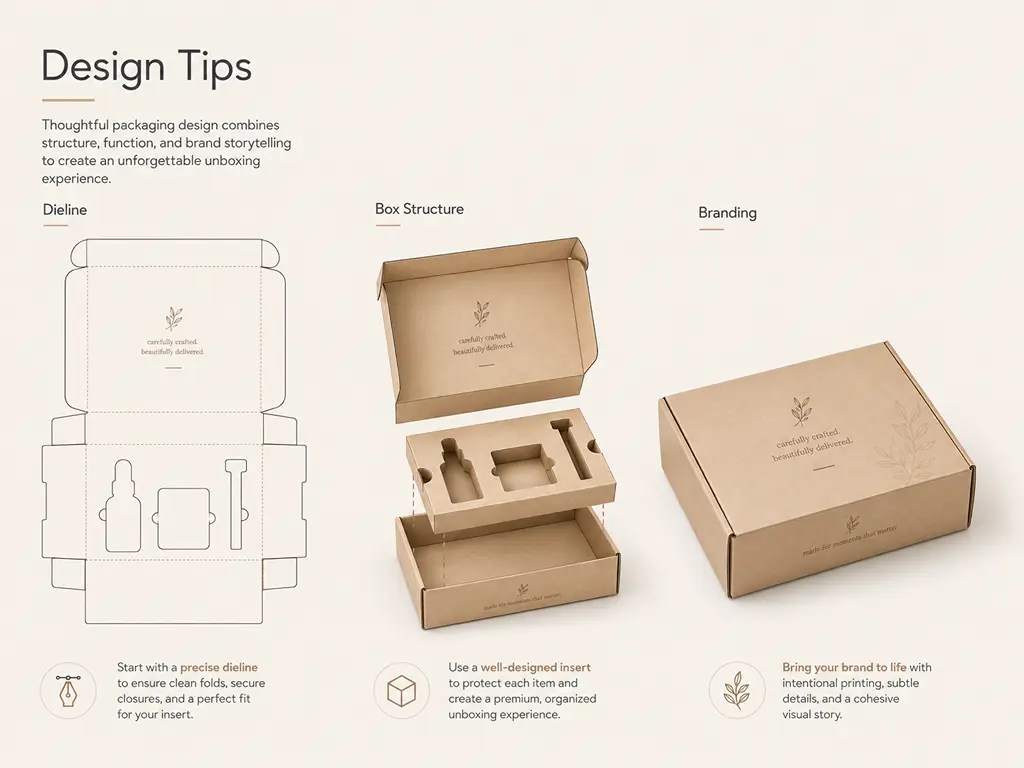
Brands developing a new structure can review PackCCP’s wider custom packaging options before deciding on materials, finishes and inserts.
If your project is still at the structural-development stage, 포장의 Dieline이란 무엇입니까?? explains how cutting, folding and artwork information are translated into a production-ready layout.
Make Product Removal Part of the Design
A product that is well protected but difficult to remove is not well fitted.
Useful structural details include:
- Finger notches
- Thumb cuts
- Pull tabs
- Side openings
- Flexible locking tabs
- Controlled clearance around bottle caps and shoulders
The customer should not need to shake the box upside down to remove the hero product.
Use Visual Hierarchy Deliberately
A multi-product kit does not need to divide space equally between every item.
The main product can be centered or given more room, while accessories and instructions occupy secondary areas.
This works especially well for:
- Skincare routines
- Electronic devices with cables
- Starter kits
- Influencer campaigns
- Subscription launches
The insert is therefore both a protective component and a layout tool.
A Good Insert Should Save Time at the Packing Table
Packaging is often judged in a sample meeting but paid for in the fulfillment area.
양산 전, ask the actual packing team to assemble several prototypes.
Watch where they hesitate.
A structure may need revision if:
- Two tabs are easily confused
- The tray springs open before loading
- Bottles have to be forced into position
- The insert works only when folded in one exact sequence
- Printed surfaces are damaged during assembly
- Accessories fall out while the mailer is being closed
These problems are relatively inexpensive to correct during sampling.
They become much more expensive after thousands of units have been produced.
PackCCP also offers custom packaging samples for checking structural fit before mass production.
Right-Sized Packaging Is More Than Using a Smaller Box
Right-sizing is useful, but it should not become a competition to remove every millimeter.
A compact mailer can:
- Reduce board usage
- Reduce unnecessary void fill
- Improve pallet utilization
- Reduce dimensional shipping exposure
- Keep the product presentation focused
But enough clearance must remain to protect the contents.
A smaller package that causes higher damage rates is not efficient packaging.
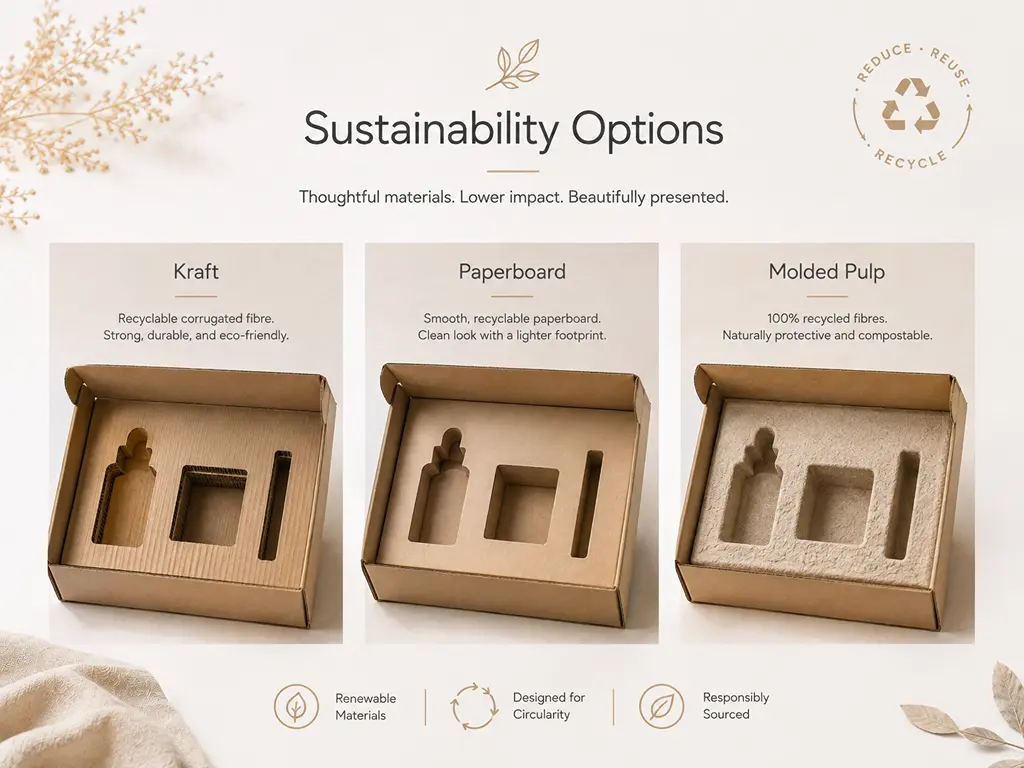
Sustainable Insert Options
Replacing foam with paper does not automatically make a packaging system sustainable.
A sensible decision considers:
- Total material use
- Product protection
- Fibre sourcing
- 재활용성
- 코팅
- Laminations
- 접착제
- Local collection systems
- Risk of product damage
PackCCP’s sustainability page outlines its approach to responsibly sourced paper, 재활용 가능한 구조물, material efficiency and production.
Keep the Material System Simple Where Possible
When both the mailer and insert can be made from compatible fibre-based materials without reducing protection, disposal instructions become easier for the customer.
Corrugated and paperboard structures are often useful for this reason.
For brands using responsible forestry claims, FSC Chain of Custody certification provides a system for tracking eligible forest-based material through the supply chain.
An FSC claim should only be made when the applicable material and supply-chain documentation support it.
FSC certification does not automatically mean that a finished package is:
- Recyclable everywhere
- Plastic-free
- Compostable
- Carbon neutral
Those are separate claims.
Australian Packaging Considerations
For brands selling into Australia, 그만큼 Australian Packaging Covenant Organisation Sustainable Packaging Guidelines provide a useful design reference.
The guidelines encourage packaging decisions that consider functionality, material efficiency and end-of-life outcomes together.
For protective packaging, this distinction matters.
Reducing board usage has little benefit if inadequate protection causes more products to be replaced and reshipped.
Prototype Before Mass Production
A dieline confirms geometry.
It cannot fully predict what happens after the package enters distribution.
A prototype should be evaluated for:
- Product insertion
- Product removal
- Assembly speed
- Internal movement
- Contact points
- Box closure
- Compression
- Drop exposure
- Final opening appearance
For higher-risk products, appropriate transport testing should also be considered before commercial production.
Do Not Call Every Drop Test an ISTA Test
This distinction matters.
An internal factory drop or shake test can be useful during development, but it should not automatically be described as an ISTA test.
그만큼 International Safe Transit Association publishes different procedures for different testing objectives.
ISTA’s 1-Series procedures are primarily integrity and screening tests. Its 3-Series procedures are general simulations designed to represent hazards found in particular distribution environments.
The appropriate procedure depends on the packaged product and the way it will travel.
If formal validation is required, identify the test requirement before finalizing the packaging rather than after mass production.
International Packaging Cases Worth Studying
Good outside examples are useful when they teach a structural principle rather than provide artwork to copy.
Semaine Health: Structure Before Graphics
박공장의 Semaine Health packaging case study is a strong example of developing an ecommerce mailer around the product first.
The project used E-flute corrugated board and a die-cut corrugated insert to keep the products positioned during longer ecommerce shipping.
The useful lesson is the sequence:
right-size the pack → confirm the structural solution → develop the visual design.
That order reduces the risk of designing attractive artwork around a structure that later needs to change.
FALELOKIKOKI: One Insert Solved More Than a Protection Problem
Smurfit Westrock’s FALELOKIKOKI case study is useful because the new corrugated insert affected more than product protection.
The company replaced assorted filler with a single-piece corrugated structure designed to organize different beauty products.
Smurfit Westrock reports that the change reduced transport-related damage complaints by 75% and made the packing process 50% faster.
That is the kind of packaging improvement buyers should look for:
less damage + less packing complexity.
Nēmah: An Insert Can Communicate as Well as Protect
PackMojo’s Nēmah Baby Shower Kit case study shows another role for the insert.
The skincare brand used a custom printed insert inside its mailer to position the products while also communicating information as the customer opened the box.
This can reduce the need for another printed leaflet when the insert already provides a suitable surface.
The lesson is not to print every visible area.
It is to make each component perform more than one useful job when that improves the customer experience.
Amazon Stemware Packaging: Less Material Can Still Mean Better Protection
Amazon’s Creating Lean Protection case study provides a useful example for fragile products.
The redesign focused on the corrugated insert as the main protective element, allowing the package to become more compact while reducing bubble wrap and the need for an additional overbox.
The principle applies well beyond glassware:
remove unnecessary packaging only after the structural protection has been improved.
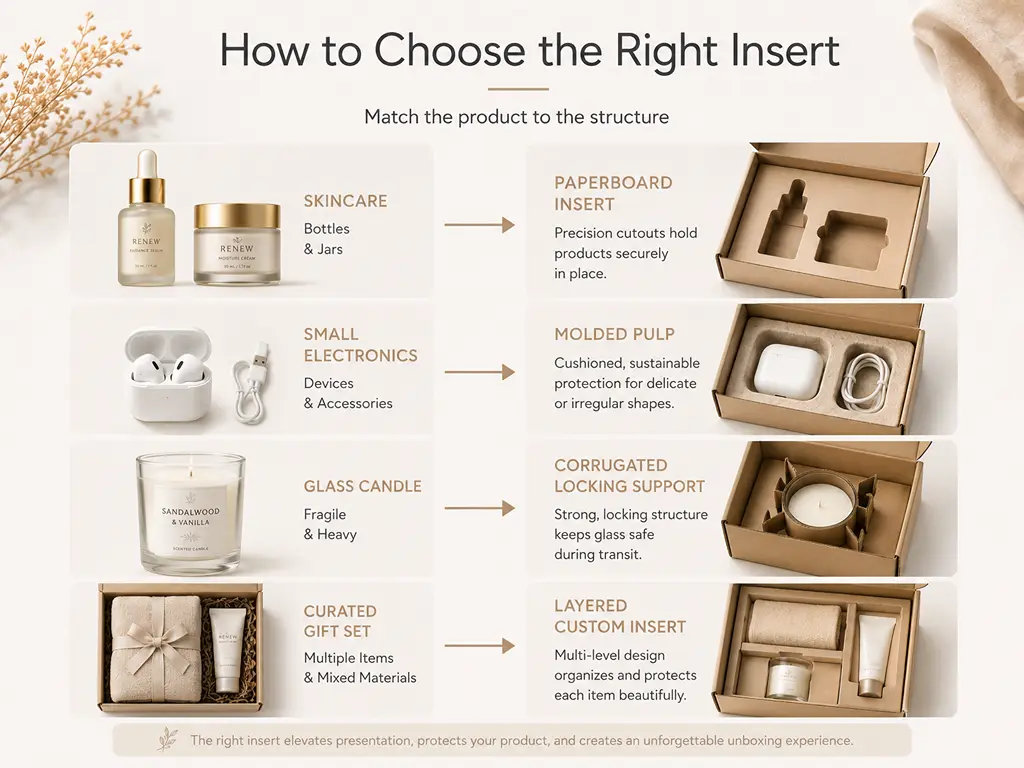
Which Products Benefit Most?
Mailer boxes with inserts are most useful when controlled positioning adds measurable value.
| Product Category | Why an Insert Helps | Typical Structure |
|---|---|---|
| Cosmetics and skincare | Separates bottles and jars | Paperboard or corrugated tray |
| 전자 장치 | Organizes device and accessories | Corrugated or molded fibre |
| Candles | Limits movement of glass vessels | Corrugated locking support |
| Subscription kits | Creates repeatable layouts | Modular paperboard insert |
| Jewelry and accessories | Keeps small items visible | Lightweight fitted tray |
| Wellness products | Organizes mixed containers | Multi-cavity structure |
| PR kits | Controls reveal and presentation | Printed paperboard or corrugated insert |
| Premium gift sets | Creates hierarchy without a rigid box | Custom layered insert |
Not every mailer needs an insert.
A soft apparel product inside a compact shipping box may gain little from one.
Adding a tray simply because premium packaging is expected to contain an insert can increase cost and material without solving a real problem.
Buyer Checklist Before Requesting a Quote
A useful packaging brief should include more than the desired box dimensions.
Prepare:
- Actual product dimensions
- Product weight
- Photos from several angles
- Number of products per box
- Preferred orientation
- Fragile or scratch-sensitive areas
- 배송 방법
- Expected order quantity
- Printing requirements
- Sustainability requirements
- 목적지 시장
- Current packaging problems
Physical samples are especially valuable when fit and surface protection are critical.
자주 묻는 질문
What is the best insert material for a mailer box?
There is no universal best material.
Paperboard works well for lightweight products and clean presentation. Corrugated is usually better when the insert needs more structural strength. Molded fibre is useful when a deeper three-dimensional cavity is required.
The final choice depends on product weight, 취약성, 표면 마무리, shipping method and packing process.
How tight should a custom insert fit?
Tight enough to limit unwanted movement, but not so tight that loading or removal becomes difficult.
The design should also account for normal manufacturing tolerances.
A cavity based on one perfectly measured sample can become too restrictive when the next product batch varies slightly.
Can paper inserts replace foam?
In many applications, yes.
골판지, 판지, molded fibre and honeycomb structures can replace foam when they provide sufficient protection.
It should not be treated as a direct material substitution.
The structure has to do the cushioning and positioning work that the foam previously performed.
Are mailer boxes with inserts recyclable?
They may be easier to recycle when both components are made primarily from compatible fibre-based materials.
하지만, recyclability depends on the complete packaging specification and local recycling infrastructure.
코팅, laminations, 라벨, adhesives and additional materials should be considered before making broad recycling claims.
Should the insert and mailer be designed by the same supplier?
In most cases, yes.
The insert affects:
- Internal box dimensions
- Required product clearance
- 집회
- Board selection
- Final package performance
Designing both components together allows the supplier to optimize the complete system rather than forcing two separately designed components to work together.
Final Takeaway
The purpose of an insert is not to make the inside of a mailer look expensive.
It is to control what happens to the product between packing and opening.
A good design keeps products separated, protects vulnerable surfaces, allows for realistic product tolerances, packs efficiently and presents the contents as intended when the customer opens the box.
That is why the insert should not be treated as an accessory added after the outer box has already been selected.
For products that genuinely require internal support, the insert and the mailer box are one packaging system.
Start with the product.
Understand how it can move, where it can be damaged, how it will be packed and how it will travel.
Then design the box around those facts—not the other way around.
Brands developing a new ecommerce packaging system can review PackCCP’s custom packaging capabilities 또는 contact the PackCCP packaging team with product dimensions, 수량, material preferences and target market.