Pour les marques vendant des produits emballés dans l’Union européenne, PPWR has moved from a future planning topic to an active compliance issue.
Regulation (UE) 2025/40 on packaging and packaging waste (PPWR) entered into force on 11 Février 2025 and has generally applied since 12 Août 2026. It changes how packaging is assessed across the EU, with requirements covering recyclability, substances of concern, packaging minimisation, labelling, conformity assessment and technical documentation.
Pour les emballages en papier, one point is easy to miss:
Paper-based does not automatically mean PPWR compliant.
A folding carton or corrugated box may still include coatings, plastic windows, couches métalliques, adhesives, inks or treatments that affect recycling or chemical compliance. The complete packaging construction matters, not the visible substrate alone.
The PPWR is also being implemented in stages. Some requirements apply now, while detailed Design for Recycling criteria and later recyclability thresholds continue toward 2030, 2035 et 2038. The European Commission published additional PPWR guidance in June 2026, and further delegated and implementing acts are still expected.
For the legal text, utiliser Regulation (UE) 2025/40 on EUR-Lex. Le European Commission PPWR page and its 2026 PPWR guidance are useful companion references.
What Are the Key PPWR Requirements for Paper-Based Packaging?
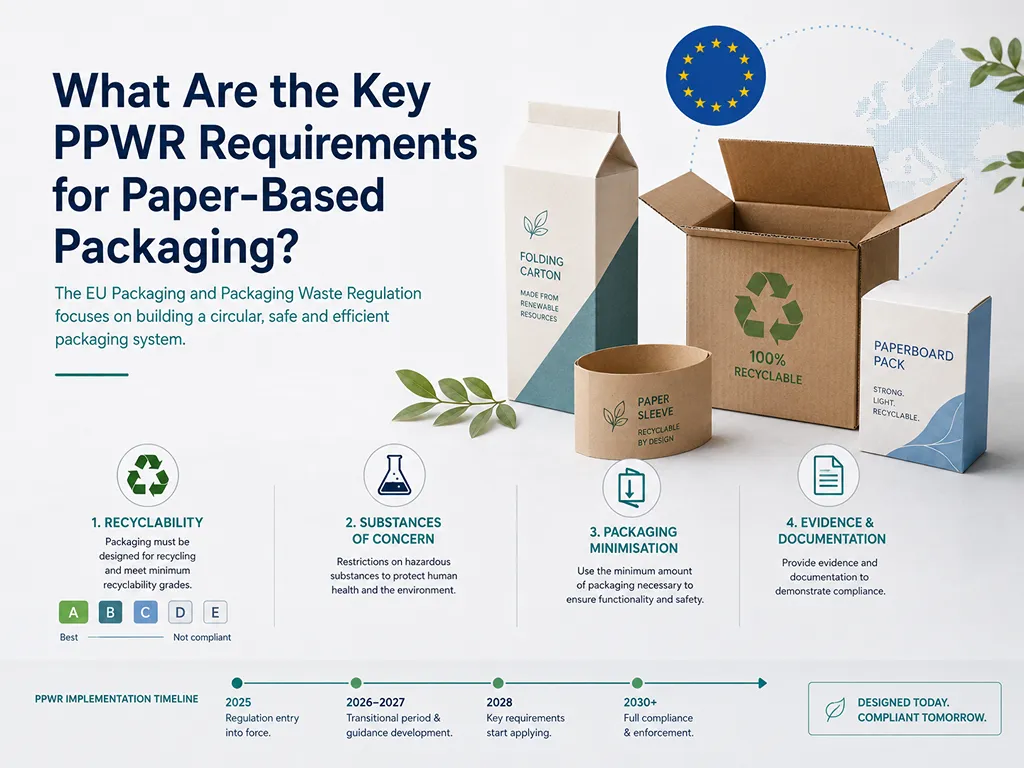
For paper boxes, cartons pliants, emballage ondulé, sleeves and other fibre-based formats, four areas deserve early attention: recyclability, substances of concern, packaging minimisation and evidence.
PPWR timeline for paper packaging
| Date | PPWR milestone | Practical meaning |
|---|---|---|
| 11 Feb 2025 | Regulation entered into force | The new EU packaging framework became law |
| 12 Aug 2026 | PPWR generally applies | Core obligations apply; PFAS limits for food-contact packaging also take effect |
| Par 1 Jan 2028 | Detailed Design for Recycling acts due | The Commission is to establish detailed recyclability criteria and performance grades |
| 1 Jan 2030 | DfR and packaging-minimisation requirements phase in | Packaging must meet applicable recyclability criteria and be minimised to the necessary weight and volume |
| 2035 | Recycled-at-scale assessment is added | Actual recycling at scale becomes part of recyclability assessment |
| 1 Jan 2038 | Grade C is generally no longer sufficient | Packaging generally needs Grade A or B to remain on the market |
The dates above should be read together with the final delegated and implementing acts applicable to the specific packaging category. The Commission’s Joint Research Centre is supporting development of the technical Design for Recycling framework.
1. Design packaging for recycling
PPWR introduces recyclability performance grades based on the share of a packaging unit considered recyclable by weight.
| Recyclability grade | Design for Recycling assessment |
|---|---|
| Grade A | ≥ 95% |
| Grade B | ≥ 80% |
| Grade C | ≥ 70% |
| Technically non-recyclable | < 70% |
From 1 Janvier 2038, packaging will generally need to reach Grade A or B rather than Grade C, subject to the detailed rules and exceptions in the Regulation.
For fibre packaging, the assessment is not limited to paperboard. Review the complete structure:
- paperboard or corrugated substrate;
- printing ink;
- varnish or barrier coating;
- laminage;
- window film;
- foil or metallised decoration;
- adhesive;
- label;
- closure or other attached components.
A useful design question is: what remains with the package when it enters the paper recycling stream, and how will those components behave during sorting and repulping?
PackCCP page de durabilité outlines its approach to recyclable structures, material efficiency and export compliance support.
2. Control substances of concern
PPWR maintains a 100 mg/kg combined concentration limit for lead, cadmium, mercury and hexavalent chromium in packaging or packaging components, subject to the Regulation’s provisions.
Food-contact packaging requires additional attention. From 12 Août 2026, PPWR restricts food-contact packaging containing PFAS at or above these thresholds:
- 25 ppb for any individual PFAS measured by targeted analysis, excluding polymeric PFAS from quantification;
- 250 ppb for the sum of PFAS measured by targeted analysis, subject to the Regulation’s method provisions;
- 50 ppm for PFAS including polymeric PFAS.
This is relevant to grease-resistant papers, takeaway packaging and coated fibre structures.
A supplier description such as water-based coating is not enough to establish compliance. The buyer needs to know the coating chemistry, intended function, applicable food-contact status, and whether supporting test or declaration evidence is available.
3. Reduce unnecessary packaging
From 1 Janvier 2030, manufacturers or importers must ensure that packaging weight and volume are reduced to the minimum necessary for packaging functionality.
PPWR specifically addresses features intended only to increase perceived product volume, including unnecessary layers, false bottoms and double walls, subject to defined exceptions.
Pour les emballages en papier, minimisation should be supported by engineering rather than by cutting board weight until the pack becomes weak.
A lighter carton is useful only if it can still withstand filling, stockage, palletisation, transport and normal customer handling.
Le 2026 Commission guidance also makes an important distinction: marketing preferences or general consumer acceptance do not automatically justify extra packaging weight or volume. Packaging features need a defensible function under the applicable criteria.
4. Do not confuse recycled paper with PPWR compliance
Recycled fibre can be a good material choice, but it does not replace the rest of the PPWR assessment.
A recycled paperboard carton may still have a difficult laminate, incompatible coating, problematic adhesive or unnecessary material. Inversement, a carefully engineered fibre construction may use several components while still being designed for an appropriate recycling route.
Pour les emballages en papier, the more useful sequence is:
required function → packaging structure → material composition → recyclability assessment → testing → documented evidence
For an overview of paperboard, corrugated, kraft and finishing options, see PackCCP’s paper packaging customisation guide.
How Do Inks, Revêtements, Laminations and Adhesives Affect Paper Packaging Recyclability?
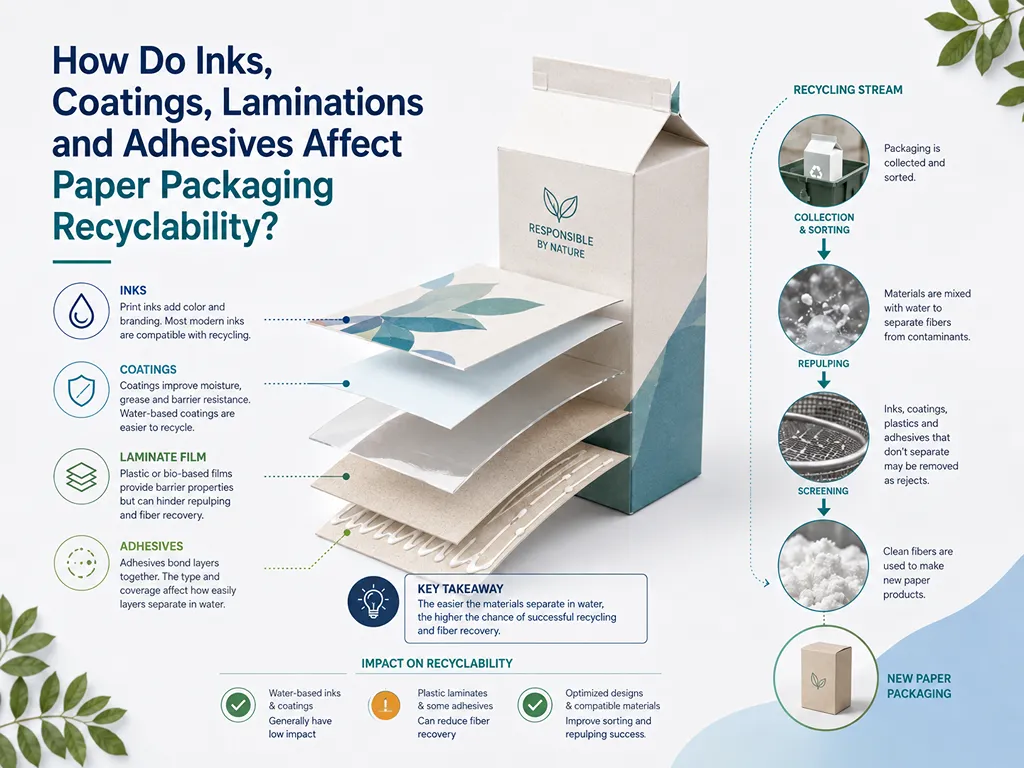
Converting paperboard into a finished package adds materials that can change how the pack behaves in recycling.
Inks
Printing does not automatically prevent fibre recovery. The practical issue is the complete print system, coverage and recycling route.
Heavy ink coverage, some UV systems, metallic effects and specialist finishes may deserve closer assessment than a conventional printed carton. Use only the print complexity needed to deliver the branding and functional requirement.
Revêtements
Coatings can provide:
- grease resistance;
- moisture or water resistance;
- heat-seal performance;
- scuff resistance;
- oxygen or aroma barriers.
The label water-based should not be used as a shortcut for recyclable. Fibre yield, screening rejects and the behaviour of the coating during the relevant recycling process are more meaningful.
Stratifications
Plastic and metallised laminations can provide strong barrier or decorative performance but add a non-fibre layer.
Before specifying one, check:
- whether the laminate is required for product protection or only appearance;
- whether coverage or thickness can be reduced;
- whether a suitable coating can provide the same function;
- how the complete structure performs in the intended recycling route.
Adhésifs
Adhesive residues can contribute to stickies or macrostickies in paper recycling, particularly where the design includes large glued surfaces, pressure-sensitive labels, self-adhesive closures or window patches.
This is one reason recyclability should be considered at BOM level, not by substrate name alone.
Cepi’s latest Paper and Board – Recyclability Laboratory Test Method, Version 3 evaluates key stages such as pulping, screening and sheet formation. It is also used as a technical basis within the 4evergreen fibre-based packaging evaluation work.
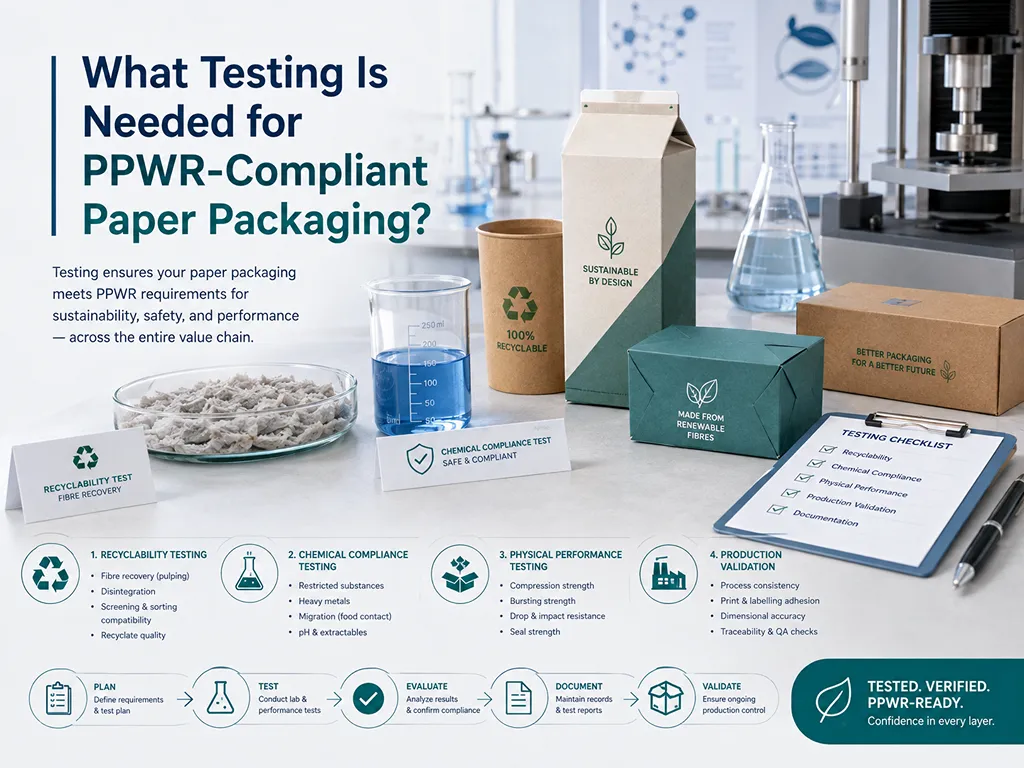
What Testing Is Needed for PPWR-Compliant Paper Packaging?
There is no single laboratory test that permanently turns every packaging format into a government-issued PPWR-certified produit.
Testing should follow the packaging construction, intended use and risk.
1. Recyclability testing
For complex fibre-based packaging, a laboratory assessment can show how the converted pack behaves during repulping and recycling.
The Cepi method can generate data on fibre recovery, rejects and sheet quality. Le 4evergreen Recyclability Evaluation Protocol provides additional industry routes for evaluating fibre-based packaging under different European recycling processes.
These are technical tools and evidence sources. They should not be presented as a universal EU-issued PPWR certificate.
2. Chemical compliance testing
The test plan may include:
- heavy metals;
- PFAS for relevant food-contact packaging;
- substances associated with inks, coatings or adhesives;
- other requirements linked to the product and intended use.
Food-contact packaging may also be subject to EU legislation outside PPWR, so the test plan should start from the BOM and application, not from a standard package of laboratory tests.
3. Physical performance testing
Material minimisation creates a practical engineering question: can the package still perform after material is reduced?
Depending on the packaging type, useful tests may include:
- compression;
- burst or edge-crush performance for corrugated formats;
- drop and vibration;
- rub resistance;
- humidity or moisture exposure;
- seal and adhesive performance.
These are not automatically “PPWR tests”. Their value is in showing why the selected structure, board weight or protective component is functionally necessary.
4. Production validation
A laboratory result describes the sample that was tested. Commercial production still needs controls that keep later batches aligned with the approved construction.
A practical chain is:
approved specification → incoming-material control → in-process inspection → batch traceability → change control
PackCCP quality-control process covers material inspection, impression, finition, structural checks and finished-product testing. Available third-party material and product reports are also shown on the certifications page.
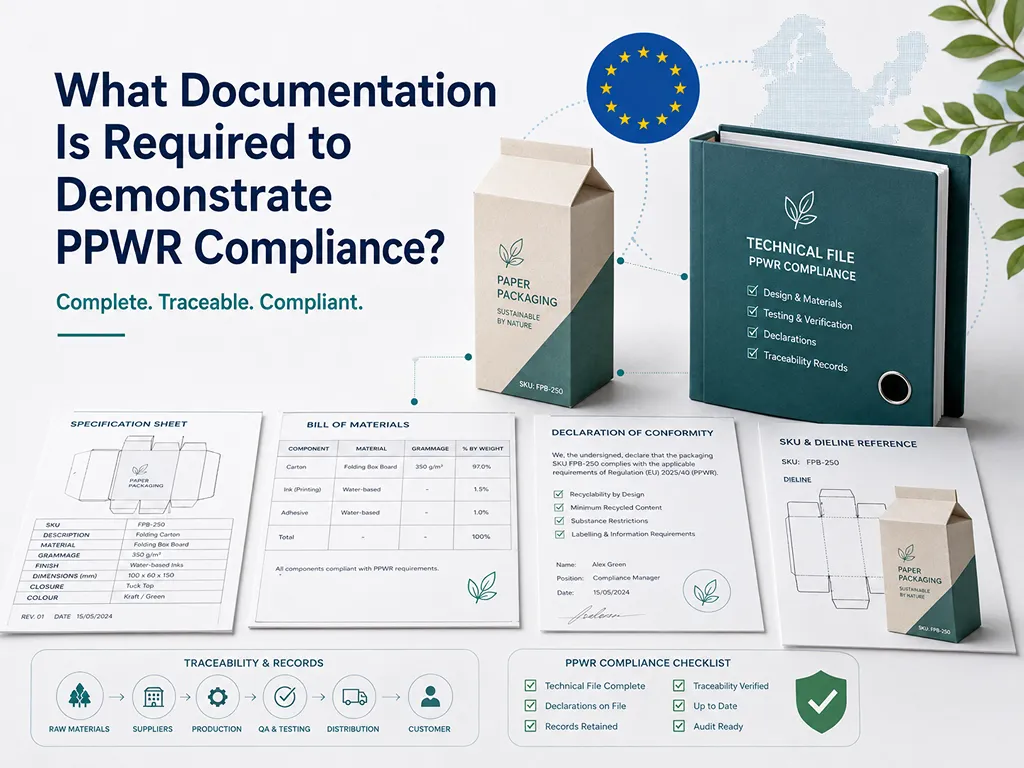
What Documentation Is Required to Demonstrate PPWR Compliance?
PPWR requires manufacturers to carry out the applicable conformity assessment and prepare technical documentation before placing packaging on the market. When conformity has been demonstrated, an EU Declaration of Conformity is required.
Annex VII describes the internal production-control procedure and the purpose of the technical file.
For a paper packaging SKU, the dossier may need to connect the finished pack to:
| Evidence area | Typical records |
|---|---|
| Packaging identity | UGS, packaging type, drawings and dieline |
| Material construction | Substrate, grammage, revêtements, films, encres, adhesives and other components |
| Compliance basis | Applicable PPWR requirements, standards and technical specifications |
| Technical evidence | Assessments, calculations, laboratory reports and recyclability data where applicable |
| Minimisation | Weight/volume assessment and justification of functional features where required |
| Production control | Approved specification, inspection records, traceability and change control |
| Conformity | EU Declaration of Conformity and supporting technical documentation |
Manufacturers generally need to retain the technical documentation and EU Declaration of Conformity for:
- 5 années for single-use packaging;
- 10 années for reusable packaging;
from the date the packaging is placed on the market.
PPWR also requires suppliers of packaging or packaging materials to provide manufacturers with information and documentation needed to demonstrate conformity. That makes supplier data part of the compliance chain.
The file should allow a reviewer to follow one clear path:
what the packaging is → what it contains → how it was assessed → what evidence supports the assessment → how production changes are controlled
A useful European implementation reference
Germany’s Central Agency Packaging Register (ZSVR), together with the German Environment Agency, published its 2025 Minimum Standard for recycling-friendly packaging and reorganised it around the future PPWR classification system.
ZSVR also provides practical guidance and discussion drafts showing how technical documentation for recyclability could be structured. The organisation explicitly notes that these examples are optional guidance rather than legally binding EU templates.
For procurement and compliance teams, this is a useful real-market example of how one EU system is preparing packaging data for the PPWR era: ZSVR Minimum Standard and practical guidance.
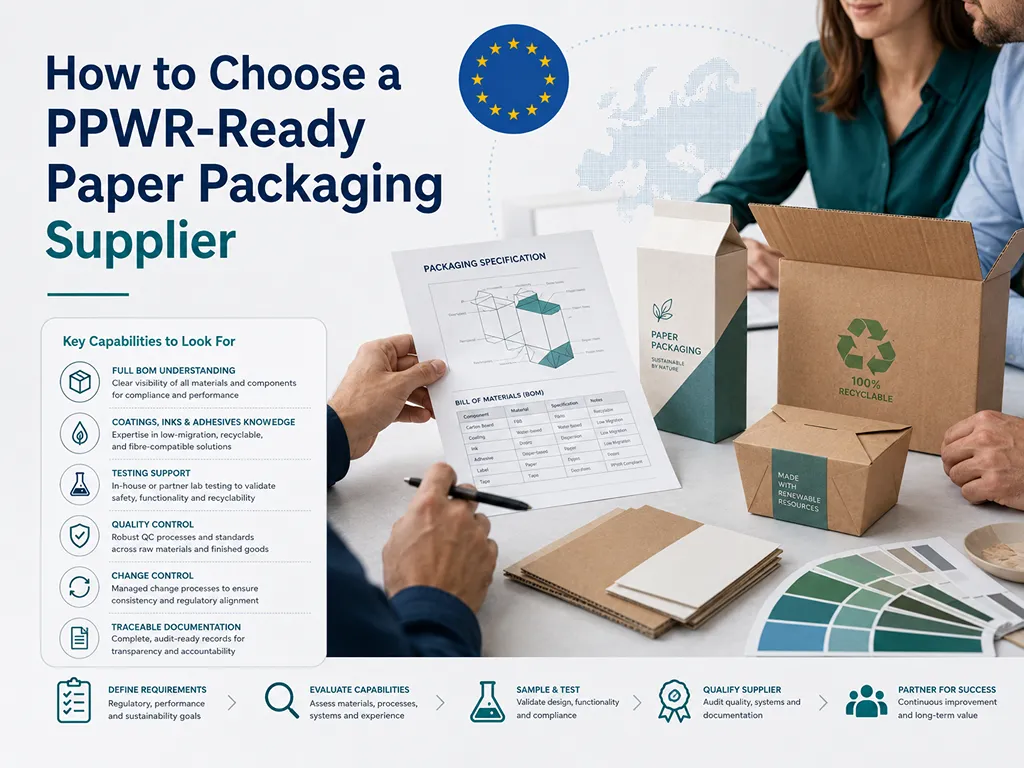
How to Choose a PPWR-Ready Paper Packaging Supplier?
A supplier should be able to support the construction behind the compliance claim.
Before approving a paper packaging project for the EU, check whether the supplier can:
- identify the complete packaging BOM rather than only the paper grade;
- provide specifications for coatings, encres, adhesives, films and finishes;
- challenge unnecessary layers or difficult multi-material structures;
- prepare samples and material data for relevant third-party testing;
- connect reports and declarations to a defined SKU or packaging family;
- control material substitutions after approval;
- maintain repeat production against an approved specification;
- provide traceable documentation when requested.
One detail matters more than it appears: material change control.
If an adhesive, revêtement, film or board is replaced after testing, earlier evidence may no longer describe the package being produced. For recurring EU orders, approved alternatives and revision records should therefore be controlled rather than handled informally.
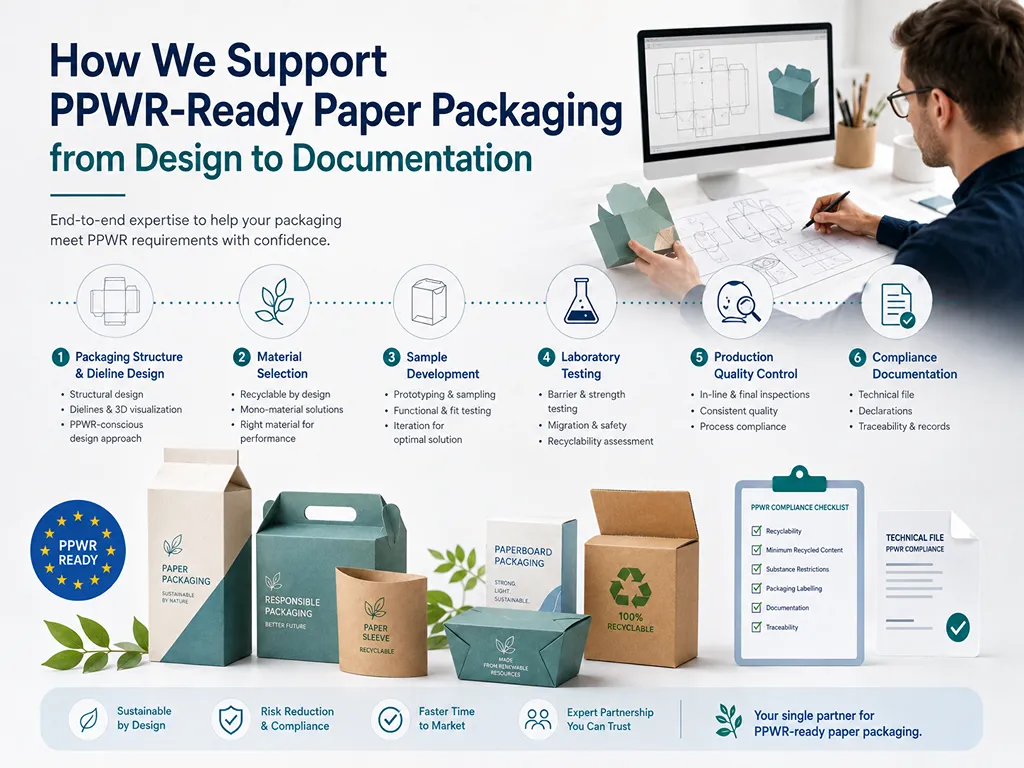
How We Support PPWR-Ready Paper Packaging from Design to Documentation?
For EU paper packaging projects, the most useful supplier work happens before mass production.
PackCCP can support the packaging-production side of that process by reviewing the intended structure and materials, developing samples, controlling approved production specifications and preparing available material or testing records for the buyer’s compliance file.
A typical review starts with:
- dieline or box structure;
- paper grade and grammage;
- full component list;
- revêtement, lamination and adhesive details;
- product application and food-contact status where relevant;
- target EU market;
- existing laboratory reports or declarations.
Where the structure is unnecessarily complex, simplification can be considered before tooling and artwork are locked. Where third-party verification is required, the test scope should be defined around the actual BOM and application.
PackCCP can provide packaging specifications and supporting supplier documentation, but the economic operator placing packaging on the EU market remains responsible for determining the applicable legal requirements and completing the required conformity process.
For new EU packaging projects, start with the PackCCP sustainability and compliance overview ou contact PackCCP with the dieline, material specification and product application.
Important: PPWR is supplemented by Commission guidance, delegated acts, implementing acts and technical standards. Detailed requirements can change as those measures are adopted. Always verify the rules applicable to the packaging category and the date the product is placed on the EU market.