Choosing the wrong mailer box size can increase shipping costs and create unnecessary product protection issues. An oversized box adds extra dimensional weight, while an undersized box leaves insufficient space for inserts or protective materials.
This guide compares common e-commerce mailer box sizes and explains how clearance space, product dimensions, and shipping requirements affect your final packaging choice.
What Are Mailer Box Sizes and Why They Matter

The right mailer box size, based on accurate inside dimensions, helps reduce shipping costs and keeps products protected during transit.
Understanding Inside Dimensions and the Bounding Box Concept
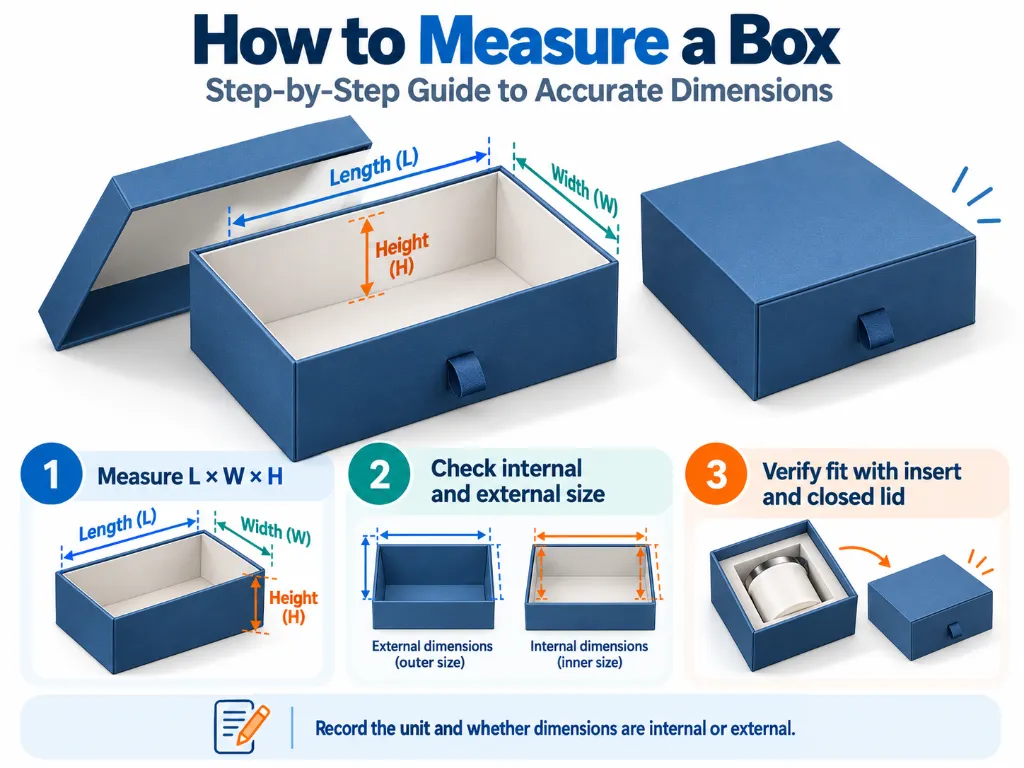
To achieve the right fit, mailer box sizing should always start with the product’s internal space requirements and a clear custom mailer box design plan. Measuring the exterior footprint only helps with warehouse planning, while inside space dictates whether your inventory actually fits.
- Inside dimensions: The usable internal cavity of the mailer box (Length × Width × Height) determines whether your product and protective materials can fit properly.
- Bounding box calculation: This formula determines the smallest possible rectangular volume that completely encloses your product and its primary packaging.
- Clearance margins: Adding around 0.25 à 1 inch of clearance is common, depending on whether the package requires tissue paper, cardboard inserts, foam protection, or other cushioning materials.
How Box Dimensions Directly Impact Shipping Costs and Brand Experience
Selecting the wrong box size creates a compounding negative effect throughout your entire fulfillment chain, driving up waste and overhead.
- Dimensional weight pricing: Oversized boxes incur heavy penalties from major carriers because volumetric pricing bills you for empty air.
- Protection du produit: Properly fitted mailers limit internal movement, dropping damage rates and saving your customer service team from processing returns.
- Fulfillment and unboxing: Optimized dimensions improve storage density on warehouse shelves, maximize pallet yields, and deliver a clean, professional unboxing moment.
Common Mailer Box Sizes for Different Products

Matching products to the right mailer box size prevents transit damage, cuts dimensional weight fees, and eliminates wasteful void fill.
Selecting the correct mailer footprint balances product protection with smart logistics. Small boxes shield compact items from rattling, while mid-to-large mailers handle high-volume orders without spiking shipping costs.
Common Mailer Box Sizes for Small Items and Accessories
Small mailers are designed for lightweight products where minimizing empty space is important. Utilizing these snug footprints minimizes empty space, reducing the need for plastic bubble wraps and paper fillers.
- 4x4x2 and 6x4x2 Inches: These compact boxes securely hold jewelry, single cosmetics, and lightweight samples without requiring excessive filler.
- 6x6x2 Inches: This square format accommodates flatter gift items, bougies, and folded scarves for a clean retail presentation.
- 7x5x2 and 8x6x3 Inches: Low-profile containers protect narrow or sensitive items like cables, compact electronics, and skincare sets during transit.
Medium to Large Mailer Sizes for Apparel and Subscription Kits
Larger mailer sizes offer the physical volume required for multi-item orders. They serve as the baseline packaging standard for most direct-to-consumer apparel brands and subscription services.
- 10x8x4 and 12x9x4 Inches: These e-commerce workhorses comfortably fit folded clothing, beauty kits, and curated gift boxes.
- 12x10x6 and 14x10x5 Inches: Deeper mailers provide the necessary depth for multi-item product bundles and winter accessories.
- 16x12x6 and 18x12x6 Inches: Generous formats handle bulky apparel, large electronics, or complete home bedding sets.
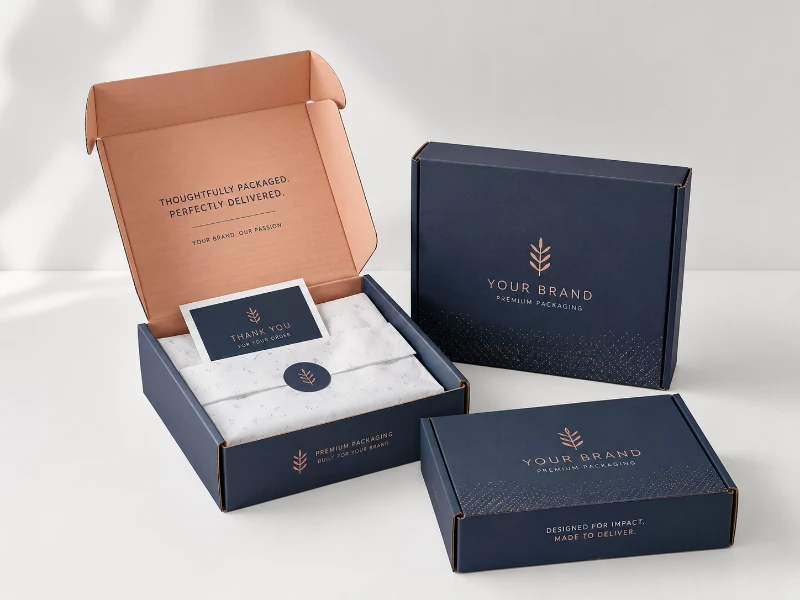
Elevate Your Brand With Custom Mailer Packaging
How to Measure Products for Mailer Boxes
Sizing mailer boxes starts with the internal bounding box of your product. Add clearance for cushioning to prevent damage and avoid carrier dimensional weight penalties.
Measuring Product Dimensions and Clearance
Measure the product at its widest and tallest points, including any parts that extend beyond the main body. You must include all outstanding parts such as handles, cords, and lids rather than just the core packaging body.
Place the item on a flat surface in its actual shipping orientation. This step establishes a precise height measurement from the base to the tallest physical point.
Add a clearance buffer of 3 à 5 millimeters (1/8 à 1/4 pouce) to the product length and width. This extra space ensures the item slides in and out of the box smoothly without tearing.
Increase your target dimensions to accommodate the thickness of tissue paper, bubble wrap, custom packaging inserts, or molded foam trays.
Converting Product Size to Box Specifications
Calculate the target internal box size by combining the product dimensions, the clearance buffer, and the packaging thickness.
Compare your target internal box size against standard industry dimensions to identify the most cost-effective shipping option.
| Mailer Size | Internal Dimensions (L x W x H) | Primary Use Cases |
|---|---|---|
| Petit | 6″ x 4″ x 2″ | Produits de beauté, bijoux, and small electronic accessories |
| Moyen | 9″ x 6″ x 3″ | Chaussures, book collections, and medium-sized retail kits |
| Grand | 12″ x 9″ x 4″ | Vêtements, coffrets d'abonnement, and multi-item gift sets |
| Plat | 10″ x 8″ x 1″ | Art prints, t-shirts, and flat promotional materials |
Distinguish internal dimensions for product fit from external dimensions to calculate shipping costs and carrier dimensional weight accurately.
Factors That Affect Mailer Box Size Selection
Selecting the right mailer box size balances product protection with shipping costs, directly impacting your bottom line and unboxing experience.
Physical Product Dimensions and Protective Clearance Requirements
You must measure your product in its final, shipping-ready state rather than using raw manufacturing specs. Neglecting the space consumed by wrapping or structural inserts leads to crushed boxes and split seams at the packing station.
- Packed-state dimensions: Measure your item in its exact shipping layout, including all tissue paper, promotional cards, and product samples.
- Cushioning clearance: Add 0.25 inches to each dimension for light wrapping, 0.5 inches for standard padding, and up to 1.0 inch for fragile items.
- Material thickness: Account for the thickness of the corrugated board, as wall thickness directly reduces your usable internal cavity space compared to the outer box footprint.
- Weight and fragility: Choose stronger board grades for heavy items up to 10 kg to prevent box compression or burst seams during transit.
Always specify inside dimensions when ordering from your supplier. This ensures your calculated clearance matches the actual usable cavity, protecting fragile corners from impact.
Logistical and Cost Factors in Size Selection
Mailer box size selection depends on more than product fit; it also affects shipping efficiency, protection, and material usage. Your box dimensions dictate your shipping rates and warehouse footprint, directly impacting long-term operational efficiency.
- Dimensional weight pricing: Minimize empty internal volume to avoid shipping inflated air, which lowers carrier volumetric billing rates.
- Order profile efficiency: Size your boxes to match your highest-volume multi-item orders instead of creating a bespoke box for every individual SKU.
- Fulfillment and storage workflows: Choose dimensions that stack cleanly on standard pallets and warehouse shelving to optimize packing speed.
- Sustainability goals: Right-size your footprint to cut material waste, reduce required void fill, and decrease transit carbon emissions.
Most brands scale efficiently by standardizing on three or four core mailer sizes. This strategy simplifies inventory management and helps packers select the correct box quickly, keeping assembly lines moving.
Custom Mailer Box Design Support for Different Product Requirements
Choosing the right mailer box size is only the first step. For brands with different products, packaging structure, matériels, and printing requirements, working with an experienced custom packaging manufacturer can help create a more efficient solution.
Packccp provides fully customized paper packaging solutions for e-commerce brands, cosmetics companies, détaillants, and other industries. From structural design and material selection to printing processes and final production, our team supports each stage of the packaging development process. With strict quality control, advanced production equipment, and sustainable material options such as recyclable paper solutions, we help brands create mailer boxes that balance product protection, visual appeal, et efficacité d'expédition. Our factory supports rapid sampling and reliable bulk production to help customers move from packaging concepts to finished products smoothly.
Custom Mailer Box Sizes for Brand Packaging

A properly sized custom mailer box helps control shipping costs, reduce unnecessary filler materials, and create a cleaner unboxing experience.
Standard and Custom Size Tiers for Common Retail Products
Selecting the correct box volume requires mapping your products to standard industry size tiers. This alignment controls shipping fees and optimizes material use across different product lines.
- Small and Micro Mailers: Ranging from 3 × 2 × 2 à 7 × 5 × 2 inches, these boxes secure high-value items like jewelry, produits de beauté, and small electronic accessories while lowering postage fees.
- Medium Transit Boxes: Spanning from 8 × 6 × 2 à 12 × 9 × 4 inches, these configurations accommodate apparel, books, and mid-sized subscription sets. They represent the most common dimensions in e-commerce fulfillment.
- Large and Extra-Large Mailers: Starting at 14 × 10 × 4 inches and extending beyond 20 × 15 × 6 inches, these hold bulky hoodies, outerwear, and multi-item product bundles.
Matching your items to standard sizes keeps unit costs low. Many suppliers can produce these common footprints as customized solutions, helping brands balance production efficiency and packaging requirements.
Operational and Financial Decisions in Mailer Dimension Planning
Dimensional planning directly impacts fulfillment speed and shipping spend. Brands must balance product protection with carrier pricing brackets during the box design phase.
- Mesure du produit: Measure product length, largeur, et profondeur. Add one inch of clearance for sturdy goods, and up to three inches for fragile items requiring protective cushioning.
- Carrier Thresholds: Select dimensions that remain below carrier dimensional weight thresholds to avoid expensive shipping penalties on lightweight but bulky parcels.
- Portfolio Standardization: Standardize on a portfolio of two to four core box sizes to simplify warehouse slotting, speed up assembly, and optimize pallet configurations.
- Snug Interior Layouts: Design snug interior layouts with custom die-cut inserts to eliminate shifting, lower damage rates, and remove the need for plastic void fill.
Limiting the variety of boxes in your warehouse accelerates packing speed. When fulfillment operators work with a standardized set of sizes, they make fewer decisions, which lowers processing errors and streamlines the packing line.
Questions fréquemment posées
What are the standard sizes of mailer boxes?
Mailer boxes generally fall into small, medium, and large categories based on internal dimensions. Small mailers range from 3x3x1 to 8x6x3 inches, often used for jewelry and cosmetics. Medium mailers range from 9x6x3 to 12x9x4 inches, serving as the core sizes for standard e-commerce shipments. Large mailers run from 18x12x4 up to 24x18x10 inches to accommodate bulkier items. The 12x9x4 inch size is one of the commonly used options for e-commerce products and subscription-style shipments.
Are mailer boxes measured by inside or outside dimensions?
Manufacturers specify and quote mailer boxes by their internal dimensions. This represents the actual usable space for your product and protective inserts. External dimensions are always larger because of the corrugated board thickness and folding flaps. While you use internal dimensions to ensure your product fits, you need external dimensions to calculate carrier shipping fees, dimensional weight, and pallet storage.
How do I know what size mailer box I need?
To find the correct size, measure your product’s maximum length, largeur, and height in its shipping-ready state, including any retail packaging. Add a clearance margin to each dimension for padding and easy packing. This margin ranges from 0.25 inches for snug fits to 0.5 ou 1 inch for fragile items requiring heavy void fill. Enfin, choose the smallest standard mailer box that meets or exceeds these adjusted dimensions to avoid paying extra for empty shipping space.
What size mailer box fits clothing products?
The ideal size depends on the garment type and quantity. A single folded t-shirt or light top fits well in a flat 14x10x2 inch or a compact 10x8x2 inch mailer. A single hoodie or sweatshirt requires a deeper box, such as 12x9x3 or 16x12x4 inches. For multi-item clothing orders or subscription boxes containing 2 à 4 garments, the 12x9x4 inch mailer is one of the commonly selected options for multi-item clothing shipments.
How much space should I leave inside a mailer box?
Keep empty space minimal to protect the product and reduce shipping costs. For non-fragile items, leave a clearance of 3 à 6 millimeters (0.12 à 0.25 inches) per side. For items needing light wrapping or void fill, leave 10 à 25 millimeters (0.4 à 1 pouce) of clearance. Ensure that empty space takes up less than 30% of the total box volume. Many brands are also reducing unnecessary empty space to meet sustainability goals and lower material waste.
Can I order custom size mailer boxes?
Oui, packaging suppliers regularly manufacture mailer boxes in fully custom dimensions to match your product’s exact footprint. You can customize dimensions within typical manufacturing ranges, such as 2x2x2 inches up to 25x25x15 inches. Minimum order quantities depend on the printing method, sélection des matériaux, structure complexity, and supplier requirements. Custom sizes help eliminate the need for extra void fill and reduce dimensional shipping rates.
Pensées finales
While generic boxes may seem convenient, choosing the right mailer size helps reduce unnecessary shipping costs and protects products during delivery. Eliminating empty space secures your inventory while dropping your fulfillment costs. Investing in precise inside dimensions protects both your bottom line and your brand reputation during unboxing.
Do not guess on your packaging dimensions—verify them. We recommend starting with a custom sample box to test the physical fit and material thickness with your actual products. Contactez notre équipe to review your structural requirements and secure your production quote.