Deciding on a Rigid Box vs Folding Carton for Premium Lipsticks directly impacts your unit margins and shipping damage rates. Sourcing the wrong format either erodes retail profitability or risks transit damage that drives up customer return rates.
This comparison explains how rigid boxes and folding cartons affect packaging cost, Versandeffizienz, und Markenpräsentation. We compare common specifications, including 1.5 mm bis 3.0 mm rigid board structures and lightweight folding carton materials, to help brands choose the right packaging format for their lipstick products.
Rigid Box vs Folding Carton Basics

Starre Boxen are commonly selected for premium lipstick collections, Geschenksets, and limited editions where protection and unboxing experience are important. Faltschachteln are widely used for core retail products because they offer better cost efficiency and easier large-scale production.
Selecting the right secondary packaging format directly dictates a brand’s margins, logistics footprint, and shelf presence. For premium lipsticks, this decision centers on structural performance and cost-to-benefit ratios.
Structural Architecture and Material Specifications
Structural choices define how the packaging manages the slim, tall form factor of premium lipstick units during handling and transport.
- Rigid Box Composition: Rigid boxes are typically made with 1.5 mm bis 3.0 mm greyboard wrapped with printed paper. The board thickness is selected according to the product size, Kastenstruktur, and protection requirements. For lipstick gift sets or designs with custom inserts, thicker board is often used to improve durability and presentation.
- Folding Carton Specifications: Manufactured from lightweight paperboard (250 Zu 400 gsm). For slim formats, we recommend 20 Zu 22 pt board to prevent panel bowing. These cartons ship flat and rely on scored lines for quick assembly. Brands can select different Faltschachtel-Stile depending on product requirements, shelf presentation, und Produktionseffizienz.
- Mechanical Behavior: Rigid boxes function as non-collapsible composite shells, resisting high compression loads. Folding cartons are thin, single-layer paperboard shells that flex under hand pressure, making them vulnerable to transit damage without outer shippers.
By controlling structural variables, brands can ensure their packaging maintains exact dimensional tolerances to keep primary lipstick tubes upright and secure.
Financial, Operational, and Brand Positioning Dynamics
The financial and operational trade-offs of both formats directly shape a beauty portfolio’s profitability and scalability.
- Cost Structures: Rigid boxes generally cost more than folding cartons because they use thicker board, require more processing steps, and often involve manual assembly. Folding cartons typically offer a lower unit cost, making them suitable for high-volume lipstick lines where packaging efficiency and margin control are priorities.
- Betriebseffizienz: Rigid boxes require manual or semi-automatic assembly, increasing packing times and occupying up to 5x more shipping volume. Folding cartons ship flat, reducing freight costs by 80% and running smoothly on high-speed automated lines.
- Brand Positioning: Rigid boxes immediately signal luxury. They serve best for limited-edition drops, flagship lines, and gift sets that require a stronger premium presentation. Many brands choose Starre Kartons für Luxusverpackungen when they want to enhance product value through structure and tactile experience. Folding cartons provide clean retail displays and easily adapt to shade updates across core high-volume ranges.
We recommend a split strategy: leverage folding cartons to maximize margins on your daily retail SKUs, and deploy rigid boxes for high-margin, collectible launches. Brands can also compare the structural differences in rigid boxes vs folding cartons when selecting packaging formats for different product lines.
Structural Differences in Lipstick Packaging
Rigid boxes use thick, pre-assembled chipboard to maximize impact protection, while folding cartons rely on flat-shipped, engineered paperboard to optimize production and logistics.
Wall Thickness and Structural Integrity
Structural durability in slim cosmetic formats directly stems from material caliper and geometric design. Rigid setups and folding cartons approach load-bearing protection from entirely different engineering baselines.
- Rigid Box Substrates: These units utilize 1.5 Zu 3.0 mm thick chipboard to form a dense, non-collapsible shell. Single lipstick units require a 1.5 mm minimum wall thickness, while multi-product sets require 2.0 mm oder mehr.
- Folding Carton Caliper: These cartons rely on 20 Zu 22 pt paperboard (230 Zu 450 GSM). To prevent panel bowing and corner collapse in tall, narrow lipstick formats, the paper grain direction must run parallel to the main fold axis.
- Impact Performance: Rigid boxes provide stronger resistance against compression and impact compared with standard folding cartons, making them suitable for premium products that require additional protection during transportation. Folding cartons do not offer standalone crush resistance and depend on outer corrugated shippers during transit.
Closure Mechanisms and Product Retention
A packaging format’s closing style determines both the physical security of the lipstick tube and the long-term integrity of the container during repeated consumer use.
- Mechanical Hardware: Premium rigid boxes integrate mechanical elements like embedded magnets rated for 500 or more cycles. Custom EVA foam or paperboard inserts immobilize the lipstick barrels to prevent rattling.
- Friction Engineering: Folding cartons secure products without hardware, utilizing a 3 Zu 5 mm tuck depth increase, dust flaps, and internal tongues or collars directly engineered into the paperboard.
- Logistical Trade-Offs: Pre-assembled rigid setups guarantee immediate structural squareness but increase shipping volume. Flat-shipped folding cartons reduce warehouse footprint by up to 80% and support high-speed automated assembly lines.
Premium Custom Lipstick Packaging Built to Scale

Rigid Box vs Folding Carton Cost
Rigid packaging costs 4x to 10x more than folding cartons, but its structural protection and luxury perception justify the premium for high-margin, DTC, and holiday lipstick sets.
Manufacturing and Material Unit Economics
Secondary packaging costs directly dictate gross margins for premium cosmetic brands. Understanding factors that influence custom lipstick packaging cost helps brands choose the right balance between packaging investment and retail positioning. The stark cost divergence between rigid boxes and folding cartons stems from raw materials and factory assembly methods.
- Rigid Box Unit Cost: Typically runs $3.00 Zu $12.00+ at standard cosmetics MOQs, though high-volume runs of simplified, lipstick-sized formats can fall between $0.80 Und $2.50.
- Premium Folding Carton Unit Cost: Ranges from $0.10 Zu $0.50 for standard designs, with highly complex executions on high-end boards topping out around $1.50.
- Relative Premium: Rigid packaging usually costs 4x to 10x more than equivalent folding cartons, translating to a 30% Zu 70% total cost premium.
- Material Specifications: Rigid boxes require a thick chipboard core (1.5mm+) and manual or semi-automated paper wrapping, whereas folding cartons use 250 Zu 400 GSM paperboard processed on high-speed automated lines.
This structural difference makes folding cartons highly scalable, while rigid boxes remain a labor-intensive investment reserved for top-tier releases.
Logistik, Schutz, and Retail Margin Impact
Beyond direct manufacturing bills, packaging choices ripple through transport logistics, warehousing, and ultimate retail pricing strategies.
- Logistical Footprint: Folding cartons ship and store flat, reducing transit volume and warehouse storage space by up to 80% compared to fully assembled rigid boxes.
- Damage and Return Rates: Thick rigid board structures can help reduce damage risks during transportation, especially for premium products shipped through e-commerce channels.
- Retail Price Premium: Rigid boxes support a 15% Zu 30% higher retail price premium, making them highly profitable for lipsticks priced above $50 and limited-edition holiday sets.
- Strategic Segmentation: Brands select folding cartons for masstige lines under $25 to preserve retail margins, while choosing rigid structures for premium direct-to-consumer launches where unboxing drives social sharing.
Analyzing the total cost of ownership helps brands balance immediate freight savings against long-term brand equity and lower return rates.
Luxury Appeal of Lipstick Packaging

Structural packaging choices and tactile finishes directly justify a 15% Zu 30% retail price premium while driving high shelf engagement.
Tactile and Structural Cues Driving Consumer Perception of Luxury
Packaging acts as a silent sales representative. When buyers browse high-density retail spaces, structural weight and tactile feedback immediately frame their expectations of the formula inside.
- Luxury signaling: Rigid boxes serve as baseline cues for cosmetics retailing above $35–$60, utilizing heavy materials and non-collapsible structures to validate a 15% Zu 30% price premium.
- Ritualistic mechanics: Magnetic closures and multi-stage reveals, like shoulder-and-neck geometries, create a deliberate physical progression that heightens perceived item value.
- Structural stiffness: Upgrading mid-tier folding cartons to premium 20–22 pt caliper paperboard prevents panel bowing and denting on the shelf.
- Tactile finishes: Soft-touch laminations, selective foil stamping, and debossed patterns supply physical feedback that directly prompts purchase decisions. These details are often achieved through advanced luxury rigid box finishing techniques that improve shelf appeal and brand recognition.
Retail Shelf Performance and Strategic Packaging Formats
Shelf performance dictates market share. Cosmetic brands must balance visual impact with spatial efficiency to win in crowded brick-and-mortar retail environments.
- Visual footprint: Rigid boxes capture high consumer attention through their heavy dimensional presence and premium display potential.
- Shelf optimization: Folding cartons can achieve strong shelf visibility through high-quality printing, interior graphics, Folienprägung, Prägung, and other finishing techniques.
- Social engagement: Interactive features, including textured wraps and drawer-style openings, prompt shoppers to handle products and share unboxing stories online.
- Portfolio architecture: A hybrid packaging approach deploys rigid boxes to anchor top-tier flagship lines, while utilizing decorated folding cartons to scale core shade selections cost-effectively.
Shipping Efficiency: Rigid vs Folding Boxes
Folding cartons slash inbound shipping volumes by 80% while rigid boxes trade shipping efficiency for structural defense and lower damage claims.
Secondary packaging architecture dictates shipping budgets and warehouse space. Choosing between flat and pre-assembled structures directly impacts your logistics costs from the production line to the retail shelf.
Volumetric Freight and Warehouse Density Dynamics
Logistics managers must evaluate how structural design determines physical footprint. Flat-packed materials optimize space, while fully assembled items incur volume premiums throughout transit.
- Inbound Volume Reduction: Folding cartons ship flat, which significantly reduces transportation volume and warehouse space compared with pre-assembled rigid boxes. This space efficiency allows 10,000 flat units to fit on just two pallets.
- 3D Volume Penalties: Pre-assembled rigid boxes made from 1.5 Zu 3.0 mm chipboard (1,200+ GSM) maintain their full 3D volume during transit. This structural permanence increases pallet counts, escalates dimensional weight charges, and raises last-mile carrier fees.
- Upstream Storage Density: Flat-packed empty folding cartons maximize upstream storage density in warehouses. Brands store up to four times more units per warehouse pallet, easing inventory management for diverse shade assortments.
- Downstream Shelf Utilization: Downstream retail shelves and fulfillment bins naturally favor the slim profiles of folding cartons. Oversized rigid boxes require larger physical footprints, which directly reduces the number of product units per shelf facing.
Brands managing broad shade catalogs require high warehouse density to maintain safety stock without paying for excessive physical space.
Operational Handling, Produktschutz, and Total Landed Cost Interplay
Protecting fragile components during global shipping requires a careful balance of structural durability and operational speed. True cost analysis must look beyond the packaging purchase price to evaluate total landed expenses.
- Assembly Labor: High-speed automated cartoning lines easily process folding cartons to lower final assembly costs. Umgekehrt, rigid boxes with embedded magnetic closures require slower, manual assembly steps.
- Damage Prevention: Thick rigid box walls reduce transit damage claims by 20% Zu 50% for premium lipsticks. This rigid shield protects delicate primary tubes and decorative finishes during long-distance distribution.
- Hybrid Alternatives: Collapsible rigid boxes offer a compromise. They ship flat to preserve inbound freight efficiency and then lock into a rigid structure at the fulfillment stage.
- Systemic Cost Balance: Financial models must weigh low-cost folding cartons ($0.10 Zu #0.50 pro Einheit) against rigid boxes ($0.80 Zu $2.50+ pro Einheit). High-margin premium products must be able to absorb the elevated shipping cube of rigid formats.
Using automated folding cartons keeps operational throughput high for mass-market retail, while luxury lines leverage the protective strength of rigid setups to minimize expensive return shipments.
Sustainability of Paper Lipstick Packaging
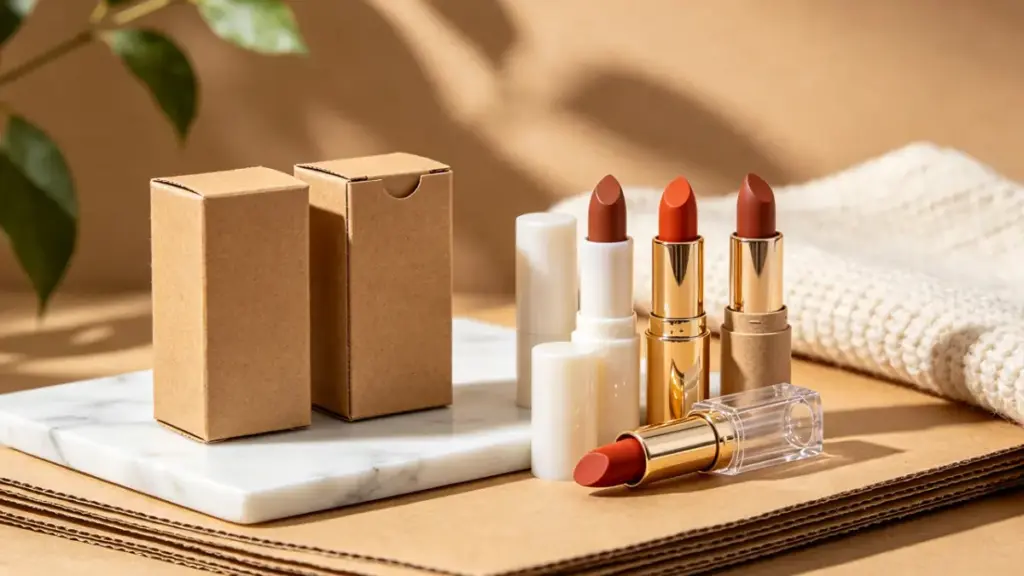
Folding cartons offer a lower raw material footprint and easier recycling, while rigid boxes offset their high material intensity by reducing transit damage and enabling long-term reuse.
Evaluating the environmental impact of your lipstick packaging requires looking at both material volume and supply chain efficiency. A packaging format that seems sustainable on paper can carry hidden ecological costs during transport and retail distribution.
Material Intensity and Logistics Lifecycle Footprint
Raw material volume and transport logistics dictate the baseline carbon footprint of secondary packaging. The physical differences between rigid and folding formats directly impact these metrics:
- Fiber Consumption: Rigid boxes require heavy 1,200 Zu 3,000 gsm chipboard with at least 1.5 mm thickness, while folding cartons use light 200 Zu 400 gsm paperboard to reduce raw material demand.
- Logistics Emissions: Flat-shipped folding cartons minimize warehouse space and transit volume, lowering transport-related emissions per unit compared to fully assembled rigid boxes.
- Produktschutz: Robust rigid construction protects delicate cosmetics, lowering retail product returns by approximately 18% and preventing the waste associated with replacement shipments.
- Scalability Cost: Folding cartons cost between $0.15 Und $1.50 pro Einheit, allowing brands to implement sustainable materials across high-volume retail lines economically.
Circularity, Recyclingfähigkeit, and End-of-Life Management
How a package behaves at the end of its life is just as critical as how we source it. Brands must balance municipal recycling realities against consumer habits:
- Recycling Stream Access: Mono-material paperboard folding cartons process easily in standard municipal recycling, whereas rigid boxes require manual disassembly of magnets, Schaumstoffeinlagen, and ribbon pulls.
- Finishing Interference: Plastic film coatings, soft-touch laminations, and metallic foils hinder fiber recovery during repulping, increasing the risk of landfill disposal.
- Post-Purchase Reusability: Premium rigid boxes often serve as long-term vanity storage, delaying their end-of-life impact, while consumers typically discard folding cartons immediately.
- Compliance Upgrades: Using FSC-certified paper materials, recycelbarer Karton, and environmentally friendly coatings helps brands achieve more sustainable packaging solutions.
Designing with end-of-life in mind helps brands avoid greenwashing traps. Choosing clean, paper-based alternatives keeps materials in the circular economy loop longer.
Choosing the Right Lipstick Box Format
Match your retail pricing and sales volume to the right structure: folding cartons protect high-volume margins under $25, while rigid boxes justify luxury price tags over $50.
Packaging Selection by Brand Tier and Retail Price Point
Retail pricing directly dictates your packaging spend and margin thresholds. Choosing the wrong format will either erode your profits or cheapen your brand identity on the shelf.
- Mass-Market and Drugstore ($5–$15): These brands require folding cartons to maintain profitability through cost-efficient, high-volume production runs.
- Prestige Brands ($20–$40): Mid-tier beauty lines use folding cartons for core retail products, but they select rigid boxes for holiday gift sets or limited editions.
- Ultra-Luxury Brands ($50+): High-end houses rely on rigid boxes built with 1.5–3.0 mm thick chipboard to signal premium value and heritage.
Logistical and Operational Alignment Across Sales Channels
Your distribution model and SKU count must align with how your packaging physically moves. Storage volume, freight costs, and assembly speeds will make or break your bottom line.
- High-Volume Retail: Brick-and-mortar operations require flat-shipping folding cartons to minimize inbound freight costs and support automated filling lines.
- Direct-to-Consumer (DTC): E-commerce brands benefit from rigid boxes with at least 1.5 mm wall thickness to reduce parcel shipping damage and customer return rates.
- SKU Complexity: High-SKU brands rely on folding cartons to manage fast design changes, whereas low-SKU brands invest in rigid boxes for high-margin impact on fewer products.
Why Choose PackCCP for Custom Lipstick Packaging?
Choosing the right packaging format is only the first step. A reliable manufacturing partner is equally important for maintaining consistent quality, Produktionseffizienz, und Markenpräsentation.
Packccp specializes in fully customized paper packaging solutions for beauty, Mode, Elektronik, und Lifestyle-Marken. Mit über 20 years of engineering experience, our team supports customers from structural design and material selection to sampling and mass production. We use FSC-certified paper materials and advanced production processes to deliver packaging solutions that balance premium appearance, Haltbarkeit, und Nachhaltigkeit.
From rigid lipstick boxes to customized folding cartons, PackCCP provides flexible solutions with fast sampling, reliable quality control, and global customer support to help brands scale their packaging projects efficiently.
Rigid vs Folding Box Checklist
This checklist provides direct structural, financial, and brand metrics to help cosmetic brands choose between rigid boxes and folding cartons for premium lipstick lines.
| Evaluation Factor | Rigid Box Standard | Folding Carton Standard |
|---|---|---|
| Per-Unit Cost | $1.80 Zu $4.00+ (at 5,000 Einheiten) | 30% Zu 70% less (starts ~$0.44) |
| Logistik & Storage | Pre-assembled; requires high storage volume | Ships and stores flat; space-efficient |
| Transportschutz | Provides stronger resistance against compression and impact | Requires outer corrugated shippers for additional protection during transportation |
| Target Volume | Economical below 500 units/month | Highly favored above 5,000 units/month |
Structural and Financial Evaluation Factors
We run hard financial and physical audits on your secondary packaging architecture before starting any production run.
- Per-Unit Cost Benchmarks: Rigid lipstick boxes range from $1.80 Zu $4.00+ at 5,000 Einheiten, while folding cartons cost 30% Zu 70% less, starting around $0.44.
- Warehouse and Logistics Impact: Pre-assembled rigid boxes require significant storage volume and increase shipping costs, whereas folding cartons ship flat to optimize warehouse efficiency.
- Protection Performance: Premium rigid boxes with 1.5mm+ chipboard and custom inserts provide enhanced protection against compression, Auswirkungen, and movement during transportation, helping safeguard delicate lipstick products during shipping.
- Production Volume Thresholds: Monthly volumes below 500 units make rigid boxes highly manageable, while volumes over 5,000 units strongly favor folding carton economics.
Brand Alignment and Customer Experience Metrics
Structural design must match how your target customer handles the product post-purchase.
- Lipstick Price Point and Positioning: Premium lipsticks priced at $25+ or luxury items at $50+ demand rigid boxes to sustain perceived value and gifting appeal.
- Customer Post-Purchase Behavior: When buyers keep, display, or reuse the packaging on vanity tables, we recommend rigid boxes over easily discarded folding cartons.
- Unboxing Experience Design: Rigid structures utilizing magnetic closures, slide drawers, or custom foam inserts create high-impact, tactile moments suitable for social media.
- Material Sustainability and Supplier Standards: We select FSC-certified recycled chipboard and request mill test reports to validate environmental claims without greenwashing.
Aligning the box architecture with the product’s retail price tier protects profit margins while delivering the exact tactile cues your customers expect.
Rigid Box vs Folding Carton FAQs
Is a rigid box better than a folding carton for lipsticks?
Rigid boxes suit premium lipsticks retailing above $25 because they improve luxury perception, protect heavier tubes, and create a memorable unboxing experience. Folding cartons work better for high-volume lines where cost, margin protection, flat storage, and retail speed are key.
Which packaging option looks more luxurious?
Rigid boxes look more luxurious because they use thicker board (typischerweise 1.5 Zu 3 mm) and feature non-collapsible, weighty structures. These setup boxes allow sophisticated opening styles like sliding drawers or magnetic closures. Folding cartons use thinner board (normalerweise 250 Zu 350 GSM) that feels lighter and more temporary, though brands can enhance them with premium finishes.
Which format is cheaper for lipstick packaging?
Folding cartons are significantly cheaper. They cost $0.10 Zu $0.50 per unit for standard cosmetic cartons, while custom rigid boxes cost $1.50 Zu $10.00 or more depending on complexity. Folding cartons also ship and store flat, which reduces shipping volume by about 80% and lowers landed logistics costs.
Are rigid lipstick boxes recyclable?
Paper-based rigid boxes are recyclable if you design them as mono-material paper structures. Many rigid boxes incorporate non-recyclable components like magnets, plastic foam inserts, metal plaques, and heavy laminations. Brands improve recyclability by replacing plastic foam with molded pulp or paperboard inserts and making magnets easy to remove.
Which packaging format protects lipsticks better?
Rigid boxes with 1.5 Zu 2.5 mm walls provide stronger resistance against crushing, Auswirkungen, and stacking forces. Combined with custom inserts or trays, they help keep lipstick products secure during international shipping and direct-to-consumer delivery. Folding cartons provide basic surface protection but lack the crush resistance of solid board.
Do luxury brands always use rigid boxes for lipsticks?
NEIN, luxury brands frequently use premium folding cartons for their core, high-volume retail lines to manage margins and logistics. They reserve rigid boxes for special editions, multi-product gift sets, holiday campaigns, and influencer PR kits where the presentation justifies the high packaging cost.
What is the typical MOQ difference between the two?
Rigid boxes have lower minimum order quantities (MOQS), often starting at 300 Zu 1,000 Einheiten, because their assembly involves more manual labor. Folding cartons require higher MOQs, normalerweise 1,000 Zu 5,000 Einheiten, because high-speed automated printing and die-cutting machines require expensive setup runs.
Which option works best for eCommerce?
For high-volume eCommerce, folding cartons paired with a robust corrugated outer mailer work best because they optimize storage, lower shipping weight, and reduce shipping costs. Rigid boxes work better for high-ticket luxury lines or multi-piece sets where maximum transit protection and unboxing justify the bulkier footprint.
Which packaging is easier to store in the warehouse?
Folding cartons are far easier to store because they ship and store flat, saving up to 80% of warehouse and retail back-room space compared to rigid boxes. Rigid boxes ship pre-assembled and occupy their full three-dimensional volume, meaning you pay to store empty space.
Can folding cartons actually look premium?
Ja, folding cartons look premium when you use thick Solid Bleached Sulfate (SBS) board in the 16 Zu 24 pt range and apply high-end finishes. Techniques like hot foil stamping, Prägung, Prägung, Spot-UV, and soft-touch coatings give folding cartons a luxurious feel that rivals rigid boxes.
Letzte Gedanken
Balancing secondary packaging costs against structural defense determines whether your lipsticks arrive pristine or damaged on retail shelves. Opting for unverified, low-grade substrates risks panel bowing and expensive product returns that quickly erode your brand reputation. Implementing our specified material standards safeguards your margins while delivering the exact tactile feedback your customers expect.
Don’t guess on paperboard calipers or rigid board thicknesses—verify them under real-world conditions. We recommend ordering a sample kit to test our structural tolerances and specialty finishes firsthand. Kontaktieren Sie noch heute unsere Verpackungsspezialisten to align your dimensions and secure your upcoming production run.