Learning how to choose packaging for a new cosmetic brand is a process where a single mistake leads to product failure or severe cash flow problems. New founders often prioritize aesthetics over formula compatibility, locking into components that degrade the product or require a Minimum Order Quantity (موك) that drains capital before the first sale.
This analysis frames the decision around technical requirements and business constraints. We evaluate how formula properties like pH and viscosity dictate material choices—such as glass versus PET—and how balancing unit cost against MOQ prevents financial overcommitment. The objective is to align the technical, ماركة, and financial variables correctly from the start.
Start with Your Product Formula
Your cosmetic formula is non-negotiable. Its chemistry, stability, and texture must dictate your packaging choices—not the other way around. Get this wrong, and the product fails.
How Formula Properties Define Packaging Needs
The chemical makeup of your product is the boss. A formula’s base (water, oil, alcohol), its pH level, and its active ingredients decide which materials are stable and safe. A low-pH acid serum or an essential oil blend can degrade or even leach from the wrong kind of plastic, but materials like glass are largely indifferent.
If you have a formula with light- and air-sensitive ingredients like Vitamin C or retinol, putting it in a clear jar is a death sentence for its efficacy. You absolutely need protective packaging—like opaque containers or airless pump systems—to keep the product stable and protect your brand’s claims.
A product’s texture and thickness directly determine the right way to get it out of the container. This is just common sense. A thick cream won’t work in a dropper, and a watery serum will make a mess in a wide-mouth jar. Viscosity dictates whether you need a pump for a cream, a dropper for a thin serum, or a squeeze tube for a gel.
Matching Packaging Components to the Formula
Once the technical requirements are locked down, you can start shortlisting components. This isn’t a creative exercise yet; it’s a process of elimination based on facts.
- Choose materials like glass, specific plastics (PET, PP), or aluminum for their chemical inertness and ability to act as a barrier. Glass is a safe bet for most sensitive formulas. With plastics, you must verify that the specific grade is compatible with your product’s chemistry.
- Select a dispensing system that functions properly with the product’s viscosity and gives the customer a good experience. This could be a pump, sprayer, or dropper. The goal is clean, controlled application, not a frustrating mess.
- Always conduct compatibility and stability testing. هذا غير قابل للتفاوض. Put your final formula in the final chosen packaging and put it through its paces—test for heat, cold, and light exposure. Look for any changes to the product or the package. If you skip this, you’re gambling with your business.
Define Your Brand Positioning
Brand positioning defines your spot in the market and in your customer’s mind. It’s the blueprint guiding every packaging decision, from materials to the message on the box.
Analyze the Competitive Landscape and Target Audience
Before you pick a single bottle, you need to know who you’re talking to and who you’re up against. Don’t just target “women.” Get specific. Are you selling to acne-prone Gen Z who finds brands on TikTok, or eco-conscious millennial professionals who scrutinize ingredient lists at Sephora? Define their demographics, their values (like clean beauty or status), and how they actually buy cosmetics. This tells you what they expect to see on a package.
التالي, map out your competitors. This includes direct rivals in your price tier and indirect alternatives, like dermatologist-led lines or multi-use products. Study their packaging like a hawk: what materials are they using (glass vs. plastic), what formats (pumps, الجرار, droppers), and what are the key messages on their boxes? Look for category-saturating aesthetics, like the minimalist white “clinical” look or the pink “self-love” التعبئة والتغليف. Know the field before you try to play on it.
Use a perceptual map to make this tangible. It’s just a simple chart plotting competitors on two axes, يحب “Price vs. Naturalness” أو “Prestige vs. Clinical.” You’ll quickly see where everyone else is clustered. The empty spaces on that map are your potential territory. That’s where your brand, and your packaging, can create a new conversation instead of just joining the noise.
Establish Your Unique Value Proposition and Brand Promise
Your unique value proposition (UVP) is the clear, superior value you offer. It’s your “why.” في cosmetics packaging, this could be a superior formulation with cleaner ingredients, a better user experience from an innovative applicator, or a stronger ethical stance like low-waste packaging. If your promise is “clinical-grade results,” your packaging needs to look precise and trustworthy. If it’s “seriously sustainable beauty,” the packaging itself must prove it with minimal materials and refill systems.
Develop a brand promise that distills this UVP into a primary benefit for the consumer. Think “Visible radiance in 7 أيام” أو “High-performance color made with 100% naturally derived pigments.” Your packaging must then provide the “reasons to believe” this promise, through on-pack elements like certifications (vegan, organic), clinical test results, or clear ingredient highlights.
أخيراً, pull this all together into a formal positioning statement. This isn’t marketing copy for your website; it’s an internal guide to keep everyone on track. It should clearly state your target audience, the market category you compete in, the unique benefit you provide, and the tangible reasons people should believe you. Every packaging choice, from the font to the material, gets filtered through this statement. If a design element doesn’t reinforce it, it gets cut.
Elevate Your Brand with Premium Rigid Boxes
Select Primary Packaging
Primary packaging’s first job is protecting the formula. Match the container to your product’s chemistry and stability needs, then balance that with brand, يكلف, and user experience.
Choosing the Right Container for Your Formula
Before you even think about aesthetics, you have to let the product’s formula dictate the packaging. The container’s job is to protect the formula’s stability and efficacy. Getting this wrong means spoiled product and a damaged brand. A stable prototype formula must be finalized before you lock in any bottle, jar, or tube.
Start by analyzing the formula’s core properties. These directly determine your technical requirements.
- Ingredient Sensitivity: Actives like Vitamin C, retinol, and many natural oils degrade with exposure to light and oxygen. For these, you need opaque, tinted, or UV-blocking containers. Airless pumps are non-negotiable for many high-performance serums with minimal preservatives.
- Chemical Makeup: The formula’s base (water, oil, alcohol) and pH level will react differently with various materials. Oil-based formulas can make some plastics brittle, while highly acidic formulas can corrode certain components. This is your first filter for materials—glass is inert and safe for most formulas, but plastics like PET, PP, and PE must be carefully matched.
- Viscosity: The thickness of your product determines the dispensing method. You can’t put a thick cream in a fine-mist sprayer. Match the dispenser to the product: thin liquids like toners work with sprayers or droppers; lotions and serums need pumps; and thick creams or masks require wide-mouth jars or squeeze tubes.
أخيراً, every potential formula-and-package combination requires compatibility testing. This isn’t optional. You fill your chosen containers with your actual formula and test for any changes in the product (لون, smell, نَسِيج) or the packaging (warping, leaking, staining). This step prevents expensive failures after launch.
Evaluating Practical and Brand Considerations
Once you have a shortlist of technically viable options, you can filter them through practical business and brand lenses. This is where you align the packaging with your market position and operational reality.
Your brand positioning is a major factor. The materials you choose send a clear signal to customers. Glass feels heavy and premium, supporting a luxury price point. Plastics are lightweight and practical, fitting mass-market or masstige brands. Your choice must align with the price you intend to charge and the customer you want to attract.
Think about the consumer’s usage ritual. A delicate serum might feel more luxurious dispensed from a glass dropper. A rich body butter in a wide-mouth jar allows for a more sensorial scooping experience. The packaging should enhance how the product is used, not complicate it.
Sustainability is another critical consideration. If your brand story is built on being clean or eco-conscious, your packaging has to back it up. Prioritize options like post-consumer recycled (تفاعل البوليميراز المتسلسل) plastics, recyclable mono-material systems (where the bottle and cap are the same plastic), and refillable concepts. But remember, formula safety comes first. Don’t choose a sustainable material that fails to protect your product.
أخيراً, you have to face the operational realities. Every packaging decision is a balance of these three constraints:
- يكلف: The unit price for the container, closure, and any decoration.
- موك (الحد الأدنى لكمية الطلب): The smallest number of units a supplier will sell. Custom packaging usually has a much higher MOQ than stock options.
- مهلة: The time from placing an order to receiving the packaging. Custom tooling and overseas shipping can add months to your timeline.
For a new brand, starting with in-stock packaging that meets your formula’s technical needs is often the smartest move. It lowers your MOQ, reduces cash risk, and gets you to market faster. You can always invest in more customized packaging once sales are proven.
تصميم Secondary Packaging
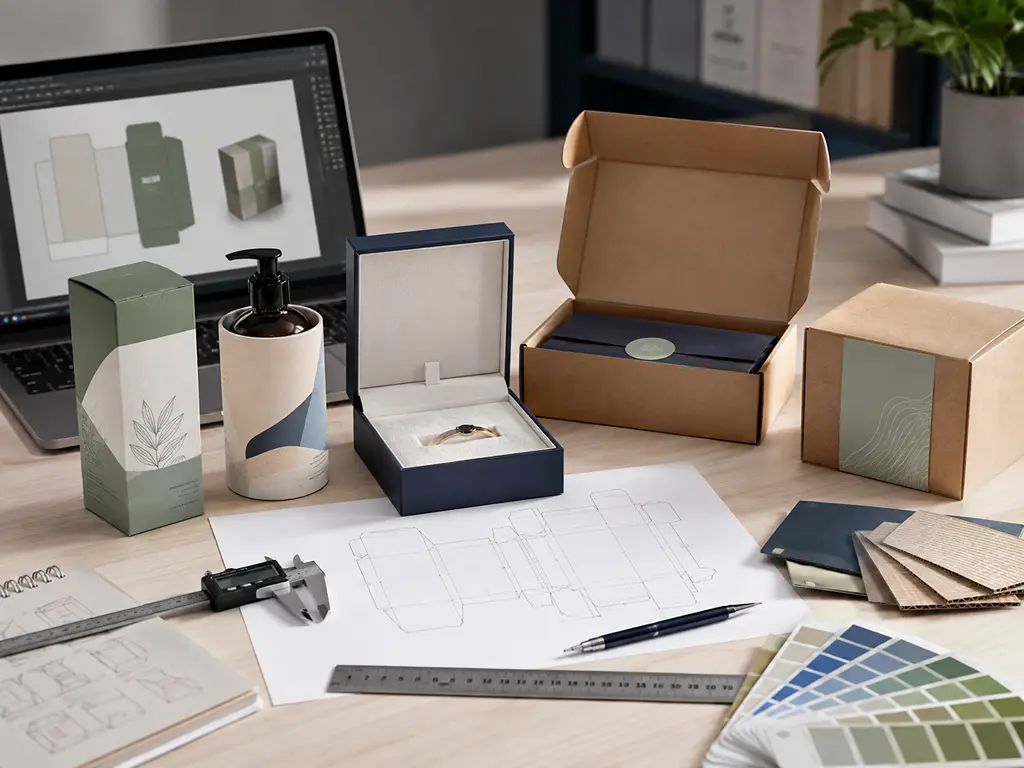
Secondary packaging is your physical billboard. It must protect the primary pack, grab attention on a crowded shelf, and tell your brand story in seconds.
Structural Design and Material Choices
التغليف الثانوي, usually the outer box or carton, does more than just look good. Its main jobs are to protect the primary container during shipping and handling, carry regulatory information, and create a strong first impression at retail.
For most cosmetic products, you’ll be working with paperboard folding cartons. The material choice here is critical. Most premium beauty brands use Solid Bleached Sulfate (اس بي اس) board because it offers a smooth, bright white surface that’s excellent for high-quality printing and finishes. A more sustainable option is Coated Recycled Board (CRB), which has higher recycled content and a slightly more textured feel, making it a favorite for “ينظف” أو “أخضر” brands.
Protection is non-negotiable, especially for fragile items like glass droppers or jars. The carton must fit the primary packaging snugly to prevent rattling and scuffing. For high-value or fragile products, you need inserts. A multi-layer system with a shoulder collar and a base disk dramatically improves drop-test performance. Other options include die-cut cradles or molded pulp cushions. The key is to balance the cost of the insert against the risk of breakage.
Sustainability choices also play a role. If your brand positioning is eco-conscious, you’ll want to use paperboard with a high recycled fiber content (like CRB) and limit complex laminations or plastic windows that hinder recyclability. For some high-end lines, reusable outer boxes or refill systems can be signaled on the carton, but remember that the primary packaging mechanics drive the actual refill process.
Graphic Design and Brand Communication
بمجرد أن يصبح الهيكل صلبًا, the graphic design does the heavy lifting for brand communication. The front panel of the box is prime real estate and needs a clear information hierarchy. Shoppers scan from top to bottom, so the layout should follow a logical path: Brand Name at the top, Product Type in the middle, and a single Key Benefit below that. Keep the brand name 2-3 times larger than other text and leave plenty of white space to avoid a cheap, cluttered look.
Finishes are what separate mass-market from premium. The standard stack for a premium beauty aesthetic includes:
- Soft-touch matte lamination: Gives the carton a velvety, modern feel.
- ختم احباط: Adds metallic accents (gold, فضي, نحاس) to logos or key text to signal luxury.
- Spot UV gloss: Applied over the matte base to create a high-contrast, light-catching effect on specific elements.
A consistent visual identity is crucial for building a recognizable brand. Use the same logo placement, typeface, color palette, and finish specifications across all your products. You can differentiate categories with accent colors or patterns, but the core family feel must remain intact. Don’t forget that secondary packaging must also carry a lot of regulatory information—like the full ingredient list (INCI), responsible party details, and batch codes. This required text often dictates the layout of the side and back panels, so you need to plan for it from the very beginning.
أخيراً, consider your sales channel. For retail, the design must have shelf impact and be legible from a meter away. For direct-to-consumer (DTC), the unboxing experience is everything. Inner printing, thoughtful inserts, and an “Instagram-worthy” presentation can turn a simple delivery into a powerful marketing moment.
مواد & Decoration Options
Your material and decoration choices aren’t just about looks. They dictate formula protection, brand perception, unit cost, and your sustainability story. Get them right from the start.
| Category | يكتب & أمثلة | Role & Impact in Cosmetics |
|---|---|---|
| مواد | زجاج | Signals luxury and provides excellent formula protection. It’s the standard for high-end serums and fragrances. |
| مواد | Plastics (PETG, PP, HDPE, تفاعل البوليميراز المتسلسل) | The industry workhorse. Versatile and cost-effective for everyday items like bottles, أنابيب, and jars. |
| مواد | Aluminum & Metal | Used for refillable systems, durable canisters, and premium components that add a modern, sustainable feel. |
| مواد | لوح الورق (اس بي اس) | The dominant material for secondary packaging. A well-designed folding carton is your product’s first impression on the shelf. |
| Decoration | الطباعة & Labeling | Screen printing is great for direct-to-container graphics. Labels offer flexibility, especially for regulatory information and frequent updates. |
| Decoration | إحباط & النقش | ختم ساخن (gold, فضي) and raised or recessed textures are clear signals of luxury and craftsmanship. |
| Decoration | الطلاءات & التشطيبات | ماتي, لمعان, and soft-touch sprays fundamentally alter the look and tactile feel of the package, shaping the consumer experience. |
| Decoration | Sustainability Note | Minimalist decoration on a certified paperboard isn’t just a trend; it’s a practical way to reinforce an eco-friendly brand message. |
Budget, موك & مهلة
Budget, موك, and lead time are linked. For a new brand, match your first order to early sales velocity, not long-term ambition. It’s a cash flow game.
Defining the Core Variables
Your total packaging budget isn’t just the unit price. You have to account for the unit cost plus tooling fees, freight, customs, and even storage. All these costs add up to your final landed cost per unit.
موك, or Minimum Order Quantity, is the smallest order a supplier will produce for you. For new brands trying to stay lean, you can find low-MOQ stock options starting in the 100–500 unit range. This helps you test the market without sinking a ton of cash into inventory.
Lead time is the clock from the moment you place your order to when the packaging lands at your facility. A typical timeline is 8–12 weeks. But if you’re doing a fully custom project with unique molds, expect that to stretch to 3–6 months.
Customization is the biggest factor that drives up your costs and timelines. If you want a unique mold, special materials, or complex decorations, be prepared for a bigger budget, a higher MOQ, and a longer wait.
Making Smart Tradeoffs for Your First Order
The fundamental tradeoff is simple. You can go for a low MOQ, which means less cash tied up upfront but a higher cost per unit. Or you can commit to a high MOQ to get a lower unit cost, but you take on more financial risk if the product doesn’t sell.
For your first launch, don’t bet the farm. Plan a small validation run of 300–500 units. This lets you test how the packaging performs with your actual formula before you commit to a warehouse full of components.
Start talking to packaging suppliers at least 6–9 months before your target launch date. And build a 2–4 week buffer into your timeline. Delays happen, so plan for them. Don’t finalize your launch marketing until you have a realistic delivery date for your packaging.
Before you sign any purchase order, get your hands on physical samples and do your own testing. Check for leaks, make sure caps fit, and verify the quality is what you expect. And get everything in writing:
- All costs, including unit price, الأدوات, and freight.
- The final terms and MOQ flexibility for reorders.
- The supplier’s policy for handling defects or quality issues.
امتثال & Labeling Requirements
Labels must follow strict rules on content and placement. Get it wrong, and you risk recalls. Plan for all the required legal text *before* you finalize any design.
Core U.S. Labeling Mandates
نحن. law divides your label into two main areas. The front, or Principal Display Panel (PDP), must show the product’s identity (يحب “Face Serum”) and its net quantity. The back or side, called the Information Panel, is where you list the ingredients, your business name and address, and any required warnings.
Your ingredient list isn’t just a simple rundown. You have to use the official INCI (International Nomenclature of Cosmetic Ingredients) names for everything. The list must be in descending order by weight, so the ingredient you use the most comes first.
The new MoCRA law, which fully kicks in for 2026, adds another layer. You must now include a U.S. contact—a phone number, mailing address, or website—on the label specifically for customers to report adverse events. This isn’t optional, and it needs to be planned into your artwork.
Be extremely careful with your marketing claims. If your label says the product treats, prevents, or cures a disease—even something like “heals eczema”—the FDA will classify it as an unapproved drug. Stick to cosmetic claims about appearance and beautifying, and make sure you can back them up.
International Rules and Packaging Design
Selling outside the U.S. means navigating a maze of different rules. على سبيل المثال, India requires a manufacturing license number and an expiry date printed on the pack. The UK requires you to flag any nanomaterials in your ingredient list with a “(nano)” tag. Each market has its own quirks that directly impact your label design.
Your package must be big enough to hold all this information. If you’re targeting multiple countries, you’ll likely need multi-language text, which eats up a lot of space. Don’t fall in love with a tiny, minimalist bottle if it can’t legally hold all the required text for your target markets.
Many regions also mandate variable data like batch codes and manufacturing dates. Your packaging material and design must be able to accept this information, usually via inkjet or laser coding. A glossy, slick surface that can’t hold ink is a production-line failure waiting to happen.
For small items like lip balms or eye creams, there’s often not enough surface area on the primary container for the full ingredient list and other details. في هذه الحالات, an outer box or sleeve becomes a legal necessity, not just a branding choice.
Choosing the Right Packaging Supplier
Finding the right packaging partner isn’t about price. It’s a strategic decision based on matching their capabilities, quality, and compliance to your specific product and brand needs.
Establishing Requirements and Sourcing Candidates
Before you even think about getting quotes, عليك أن تعرف بالضبط ما الذي تطلبه. Nailing down your requirements is the only way to avoid wasting time with the wrong partners and getting mismatched proposals.
- Define your brand’s market position. Are you a mass-market brand, premium, or outright luxury? This decision sets the bar for material quality, ينهي, and what you should expect to pay. A supplier specializing in high-volume PET bottles likely isn’t the right fit for a brand built on heavy glass jars.
- Match packaging to your product’s formula. Your product’s chemistry dictates the packaging, not the other way around. If you have sensitive skincare actives like vitamin C, you need packaging that protects them, like an airless pump or an opaque container. Get this wrong, and you risk a failed product.
- Forecast your launch volumes. Be realistic about the size of your first production run. This number has to align with a supplier’s Minimum Order Quantities (موك). Standard MOQs can start at 5,000 وحدات, so ensure your forecast and budget can handle it.
- Find potential partners. The best suppliers are often found at industry trade shows, where you can see and feel physical samples. Referrals from contract manufacturers or other brand founders are also solid gold. Specialized online directories can work, but you’ll need to vet them heavily.
Evaluating Suppliers and Making the Final Choice
Once you have a shortlist, the real work begins. This is where you separate the sales pitches from the partners who can actually deliver on their promises. It’s all about verification.
- Assess their capabilities and quality control. Dig into their customization options and material variety. Pay close attention to their ability to maintain color consistency across different batches. A slight color shift on your packaging can damage brand coherence on the shelf.
- Request physical samples. Never skip this step. Get samples to test everything—the build quality, how the closure feels when you open and close it, and most importantly, run compatibility tests with your actual formula to check for leaks or reactions.
- Verify regulatory compliance. Ask for their certifications (like ISO 9001) and material safety documentation. You need proof they meet the standards for your target markets, whether it’s in the US or EU. A supplier who can’t provide this paperwork is a major red flag.
- Use a weighted scorecard. Don’t just go with your gut or the lowest price. Create a simple scorecard to rate your top contenders on the factors that matter most to your brand—like quality, يكلف, lead time, and service. It makes the final choice objective and much easier to defend.
Frequently Asked questions
How do I choose cosmetic packaging?
Choosing cosmetic packaging means balancing your product’s formula with your brand’s style, ميزانية, وأهداف الاستدامة. Start by defining your product’s needs, like protection from light or air. Then, select materials and a dispenser—like a pump or dropper—that fit your brand’s look and make the product easy for customers to use. Always test your formula with the packaging to ensure they are compatible.
How much does cosmetic packaging cost?
For a new brand, cosmetic packaging can cost anywhere from $0.15 لأكثر من $5.00 لكل وحدة. A common starting budget for a first run is often between $1,500 و $3,000. As a guideline, many indie brands aim to keep packaging costs around 5–12% of the product’s retail price. The final cost depends on the material, order quantity, and any custom printing or finishes.
Should I use glass or plastic?
The choice between glass and plastic depends on your brand, منتج, والميزانية. Glass often feels more luxurious and is great for protecting sensitive formulas like serums, but it costs more and is heavier to ship. Plastic is lightweight, دائم, and more affordable, making it a practical choice for products like cleansers, body lotions, and items sold online. Many brands use a mix, saving glass for their hero products.
What is the MOQ?
MOQ stands for Minimum Order Quantity. It’s the smallest number of units a manufacturer will produce for you in a single order. لتغليف مستحضرات التجميل, this can range from 50–500 units from a specialized small-batch supplier to 5,000–10,000 units from a larger factory. Ordering more units usually lowers the price per piece, but for a new brand, starting with a lower MOQ helps manage costs and reduces inventory risk.
What information is required on cosmetic packaging?
Cosmetic labels must include several key pieces of information to comply with regulations. This typically includes the product’s name, the net quantity, the name and address of the business responsible, a full ingredient list, and any necessary warnings or directions for safe use. Requirements differ by country, so it’s important to check the rules for every market you plan to sell in.
How do I choose a manufacturer?
Look for manufacturers that specialize in the beauty industry, as they understand the quality and regulatory standards. Start by defining your needs, including product type, desired materials, and estimated order volume. Compare suppliers based on their minimum order quantities (موك), التسعير, and lead times. Always request samples to test for quality and compatibility with your product before placing a large order. Good communication and a track record with brands similar to yours are also strong indicators of a reliable partner.
الأفكار النهائية
Choosing packaging based on trends or unit price alone is a direct path to spoiled product and wasted capital. The disciplined process of matching formula, ماركة, and supplier is your primary defense against costly launch failures. This moves your packaging from a simple expense to a strategic asset.
Don’t leave compatibility and compliance to chance. The next step is to translate this strategy into physical components that match your formula and budget. اتصل بفريقنا to review your specifications and get samples for validation.